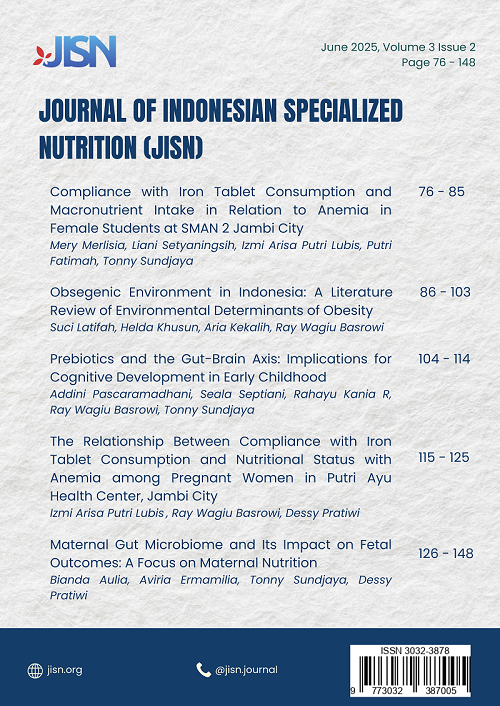
THE RELATIONSHIP BETWEEN COMPLIANCE WITH IRON TABLET CONSUMPTION AND NUTRITIONAL STATUS WITH ANEMIA AMONG PREGNANT WOMEN IN PUTRI AYU HEALTH CENTER, JAMBI CITY
DOI:
https://doi.org/10.63953/jisn.v3i2.37Keywords:
Anemia in Pregnancy, Compliance of Iron Tablet Consumption, Chronic Energy Deficiency, Maternal HealthAbstract
Background: Anemia during pregnancy remains a significant public health concern in Indonesia, with a high prevalence and adverse outcomes for both mothers and infants. Iron supplementation and maternal nutritional status are key factors in preventing anemia. This study aimed to examine the association between compliance with iron tablet consumption and nutritional status (chronic energy deficiency) with the incidence of anemia among pregnant women. Methods: A cross-sectional study was conducted at Putri Ayu Health Center, Jambi City, involving 100 pregnant women selected using accidental sampling. Data on hemoglobin levels, upper arm circumference (MUAC), and iron tablet intake were collected through interviews and direct measurement. Anemia was defined as Hb <11 g/dL. Nutritional status was categorized based on MUAC <23.5 cm as chronic energy deficiency (CED). Data were analyzed using descriptive statistics and bivariate (Chi-square) analysis. Results: While statistical associations between CED and iron tablet compliance with anemia were not significant, higher proportions of anemia were observed among women with CED and those who consumed fewer than 30 tablets. Additionally, descriptive trends showed that women who began supplementation early in pregnancy—particularly in the first trimester—were less likely to develop anemia compared to those who initiated later. Conclusions: Although not statistically significant, the findings suggest that poor nutritional status and low adherence to iron tablet supplementation may increase the likelihood of anemia in pregnancy. Early and consistent supplementation, particularly from the first trimester, should be emphasized in antenatal care programs to prevent iron deficiency-related complications.
References
World health Organization. Intermittent iron and folic acid supplementation during pregnancy [Internet]. 2023. Available from: https://www.who.int/tools/elena/interventions/intermittent-iron-pregnancy
Ministry of Health Republik Indonesia. Riset Kesehatan Dasar (Riskesdas) 2018. 2019.
Helmyati, S., Fauziah, L. A., Kadibyan, P., Sitorus, N. L., & Dilantika, C. (2024). Relationship between Anemia Status, Sleep Quality, and Cognitive Ability among Young Women Aged 15-24 Years in Indonesia (Analysis of Indonesian Family Life Survey (IFLS) 5). Amerta Nutrition, 7(3SP), 1–9. [https://doi.org/10.20473/amnt.v7i3SP.2023.1-9
Raihan SA, Firmansyah MF, Martanto NSP, Zahrawani SA, Ferrynda TP, Maskhuriyah UE, et al. Capturing The Effect of Iron Intake on The Incidence of Anemia in Pregnant Women. Proc Int Conf Halal Food Heal Nutr. 2024;2(1):155–62.
Yanti FD, Ginting RMS, Susanti E. The Effect of Chronic Energy Deficiency, Anemia, and Compliance with Iron Supplement Consumption in Pregnant Women on Low Birth Weight. J Heal Nutr Res. 2024;3(1):68–73.
Berthelin AA, Ulfa L, Kridawati A. Status Gizi dan Kepatuhan Konsumsi Tablet Fe dengan Kejadian Anemia pada Ibu Hamil di Puskesmas Kecamatan Tebet. J Genta Kebidanan. 2022;11(2):32–7.
Lina, Arbaiyah, Meliani Sukmadewi Harahap. Relationship between Chronic Energy Deficiency and Compliance with Taking Fe Tablets with the Incidence of Anemia in Pregnant Women at Kuala Simpang City Health Center Aceh Tamiang. Sci Midwifery. 2022;10(4):3047–52.
Means RT. Iron deficiency anemia. Hematology. 2013;18(5):305–6.
Obeagu EI. Pregnancy-Associated Anemia and Its Relationship with Gestational Age : A Pregnancy-Associated Anemia and Its Relationship with Gestational Age : A Review. 2024;(December):2–7.
Fathoni I, Hasanah N, Ngo NF. Kepatuhan Mengkonsumsi Tablet Fe dan Status Gizi Berhubungan dengan Kejadian Anemia pada Ibu Hamil di Puskesmas Lempake Kota Samarinda. J Med Karya Ilm Kesehat. 2023;7(2).
J Galani V, N Patel N, P Patel S, H Rabari J. Prevalence, Risk Factors and Prescribing Trends of Iron Deficiency Anemia in Pregnancy at a Tertiary Care Hospital, India. Mathews J Gynecol Obstet. 2023;7(1):1–9.
Sekartini, R. et al. Iron-Deficiency Anemia: Indonesia's Striving. Asia Pacific Journal of Pediatrics and Child Health 5, (2022).
Sungkar, A.; Bardosono, S.; Irwinda, R.; Manikam, N.R.M.; Sekartini, R.; Medise, B.E.; Nasar, S.S.; Helmyati, S.; Ariani, A.S.; Nurihsan, J.; et al. A Life Course Approach to the Prevention of Iron Deficiency Anemia in Indonesia. Nutrients 2022, 14,277. https://doi.org/10.3390/nu14020277
Downloads
Published
Issue
Section
License
Copyright (c) 2025 izmi arisa putri lubis, Ray Wagiu Basrowi, Dessy Pratiwi

This work is licensed under a Creative Commons Attribution-ShareAlike 4.0 International License.
Authors retain copyright and grant the journal the right of first publication with the work simultaneously licensed under a Creative Commons Attribution-ShareAlike 4.0 International (CC-BY-SA) that allows others to share the work with an acknowledgment of the work's authorship and initial publication in this journal.
Authors are able to enter into separate, additional contractual arrangements for the non-exclusive distribution of the journal's published version of the work (e.g., post it to an institutional repository or publish it in a book), with an acknowledgment of its initial publication in this journal.
Authors are permitted and encouraged to post their work online (e.g., in institutional repositories or on their website) prior to and during the submission process, as it can lead to productive exchanges, as well as earlier and greater citation of published work.
LICENSE TO PUBLISH
- All material published by the Journal of Indonesian Specialized Nutrition is protected under International copyright and intellectual property laws. Journal of Indonesian Specialized Nutrition is licensed under a Creative Commons Attribution-ShareAlike 4.0 International (CC-BY-SA) or an equivalent license as the optimal license for the publication, distribution, use, and reuse of scholarly works.
- This license permits anyone to compose, repair, and make derivative creations even for commercial purposes, as long as appropriate credit and proper acknowledgment of the original publication from a journal are made to allow users to trace back to the original manuscript and author.
- You must give appropriate credit, provide a link to the license, and indicate if changes were made. You may do so in any reasonable manner, but not in any way that suggests the licensor endorses you or your use. If you remix, transform or build upon the material, you must distribute your contributions under the same license as the original.