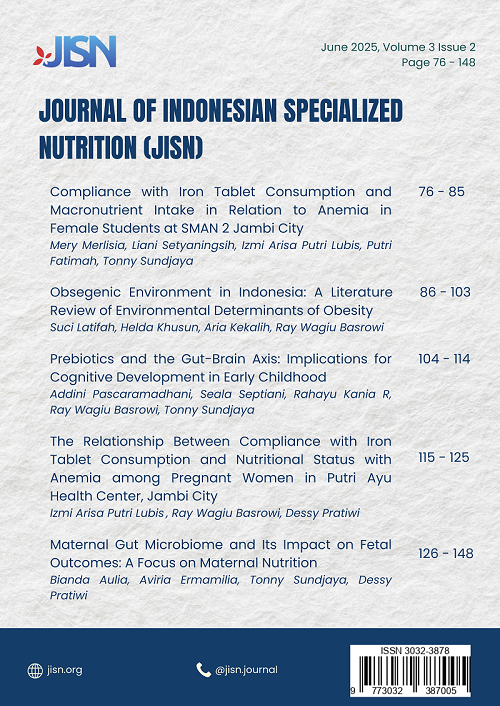
PREBIOTICS AND THE GUT-BRAIN AXIS: IMPLICATIONS FOR COGNITIVE DEVELOPMENT IN EARLY CHILDHOOD
DOI:
https://doi.org/10.63953/jisn.v3i2.45Keywords:
Prebiotics, gut-brain axis, cognitive development, early childhood, gut microbiotaAbstract
Background: Many factors influence cognitive development in early childhood, one of the latest is including gut health. Recent evidence places the role of a mediator of brain function on the part of the gut-brain axis, with nutrition overall and prebiotics specifically being imperative. Prebiotics stimulate selectively the grow of beneficial bacteria in the gut with potential implications on neurodevelopment. Methods: A narrative review that included peer-reviewed articles between 2010-2024 was conducted using PubMed, Scopus, and Google Scholar. Animal models and human clinical trials, both examining the impact of prebiotics on cognitive measures, were incorporated. Results: Prebiotics such as GOS, FOS, and resistant starch were found to increase the production of short-chain fatty acids, modulate the immune system, and excite neurotransmitter pathways. Clinical trials showed improved attentional ability and emotional control in prebiotic-supplemented formula-fed infants. Preclinical research showed enhanced memory and reduction in anxiety-like behaviors in animal models following ingestion of prebiotics. Conclusion: Prebiotics play a key role in cognitive development in early childhood through modulation of gut microbiota and neuroimmune signaling. Food-based prebiotics offer a sustainable approach to early brain development. Longitudinal studies are needed to demonstrate long-term benefits.
References
Cryan JF, Dinan TG. Mind-altering microorganisms: the impact of the gut microbiota on brain and behaviour. Nat Rev Neurosci. 2012;13(10):701–12. https://doi.org/10.1038/nrn3346
Milani C, Duranti S, Bottacini F, Casey E, Turroni F, Mahony J, et al. The first microbial colonizers of the human gut: Composition, activities, and health implications of the infant gut microbiota. Microbiol Mol Biol Rev. 2017;81(4):e00036-17. https://doi.org/10.1128/MMBR.00036-17
Dalile B, Van Oudenhove L, Vervliet B, Verbeke K. The role of short-chain fatty acids in microbiota–gut–brain communication. Nat Rev Gastroenterol Hepatol. 2019;16(8):461–78. https://doi.org/10.1038/s41575-019-0157-3
Tognini P. Gut microbiota: A potential regulator of neurodevelopment. Front Cell Neurosci. 2017;11:25. https://doi.org/10.3389/fncel.2017.00025
Clarke G, Grenham S, Scully P, Fitzgerald P, Moloney RD, Shanahan F, et al. The microbiome–gut–brain axis during early life regulates the hippocampal serotonergic system in a sex-dependent manner. Mol Psychiatry. 2013;18(6):666–73. https://doi.org/10.1038/mp.2012.77
Kadim M, Masita BM. The importance of gut health in early life for long term health. World Nutr J. 2022;5(S2):1–8. https://doi.org/10.25220/wnj.v05.s2.0001
Kartjito MS, Yosia M, Wasito E, Soloan G, Agussalim AF, Basrowi RW. Defining the relationship of gut microbiota, immunity, and cognition in early life—A narrative review. Nutrients. 2023;15(12):2642. https://doi.org/10.3390/nu15122642
Gibson GR, Hutkins R, Sanders ME, Prescott SL, Reimer RA, Salminen SJ, et al. Expert consensus document: The International Scientific Association for Probiotics and Prebiotics (ISAPP) consensus statement on the definition and scope of prebiotics. Nat Rev Gastroenterol Hepatol. 2017;14(8):491–502. https://doi.org/10.1038/nrgastro.2017.75
Bravo JA, Forsythe P, Chew MV, Escaravage E, Savignac HM, Dinan TG, et al. Ingestion of Lactobacillus strain regulates emotional behavior and central GABA receptor expression in a mouse via the vagus nerve. Proc Natl Acad Sci USA. 2011;108(38):16050–5. https://doi.org/10.1073/pnas.1102999108
O’Mahony SM, Clarke G, Borre YE, Dinan TG, Cryan JF. Serotonin, tryptophan metabolism and the brain–gut–microbiome axis. Behav Brain Res. 2015;277:32–48. https://doi.org/10.1016/j.bbr.2014.07.027
Vandenplas Y, De Greef E, Veereman-Wauters G. Prebiotics in infant formula. Gut Microbes. 2015;6(2):134–9. https://doi.org/10.4161/19490976.2014.972236
Arslanoglu S, Moro GE, Schmitt J, Tandoi L, Rizzardi S, Boehm G. Early dietary intervention with a mixture of prebiotic oligosaccharides reduces the incidence of allergic manifestations and infections during the first two years of life. J Nutr. 2008;138(6):1091–5. https://doi.org/10.1093/jn/138.6.1091
Scholtens PA, Alliet P, Raes M, Alles MS, Kroes H, Boehm G, et al. Fecal secretory immunoglobulin A is increased in healthy infants who receive a formula with short-chain galacto-oligosaccharides and long-chain fructo-oligosaccharides. J Nutr. 2008;138(6):1141–7. https://doi.org/10.1093/jn/138.6.1141
Burokas A, Arboleya S, Moloney RD, Peterson VL, Murphy K, Clarke G, et al. Targeting the microbiota–gut–brain axis: prebiotics have anxiolytic and antidepressant-like effects and reverse the impact of chronic stress in mice. Biol Psychiatry. 2017;82(7):472–87. https://doi.org/10.1016/j.biopsych.2016.12.031
van de Wouw M, Boehme M, Lyte JM, Wiley N, Strain C, O’Sullivan O, et al. Short-chain fatty acids: microbial metabolites that alleviate stress-induced brain–gut axis alterations. J Physiol. 2018;596(20):4923–44. https://doi.org/10.1113/JP276431
Savignac HM, Corona G, Mills H, Chen L, Spencer JP, Tzortzis G, et al. Prebiotic feeding elevates central brain derived neurotrophic factor, N-methyl-D-aspartate receptor subunits and D-serine. Neurochem Int. 2013;63(8):756–64. https://doi.org/10.1111/nmo.12427
Ariestya AW, Yuniwarti EN, Widyastuti Y, Harimurti S. Potential of green banana resistant starch as a prebiotic in regulating gut microbiota and promoting brain function: an in vivo study. J Appl Biol Biotechnol. 2021;9(3):24–30. https://doi.org/10.20473/jnfs.V6i1.2021.34-41
Widodo A, Wibowo AA, Suprihatin R. Galactomannan from jackfruit seeds and its impact on gut microbiota and neurodevelopment in early life. Asian J Clin Nutr. 2023;15(1):45–52. https://doi.org/10.47830/jinma.vol73.iss2.123
Sitorus NL, Dilantika C, Basrowi RW. Perspective of Indonesian pediatricians on the role of prebiotic-supplemented formula towards immunity, growth and development in preterm infants: A preliminary data. AMNT. 2021;5(1SP):34–42. https://doi.org/10.20473/amnt.v5i1SP.2021.34-42
Oswari H, Widodo AD, Handayani F, Juffrie M, Sundjaya T, Bindels J, et al. Dosage-related prebiotic effects of inulin in formula-fed infants. Pediatr Gastroenterol Hepatol Nutr. 2019;22(1):63–71. https://doi.org/10.5223/pghn.2019.22.1.63
Bienenstock J, Kunze WA, Forsythe P. Microbiota and the gut–brain axis. Nutr Rev. 2015;73(suppl_1):28–31. https://doi.org/10.1093/nutrit/nuv019
Kartjito MS, Umam AF. Probiotics and synbiotics as potential biotics in gut health-promoting nutrition. J Indones Spec Nutr. 2024;2(1):29–36. Available from: https://jisn.org/index.php/jisn/article/view/16
Agustina R, Kok FJ, van de Rest O, Fahmida U, Firmansyah A, Lukito W, et al. Randomized trial of probiotics and calcium on diarrhea and respiratory tract infections in Indonesian children. Pediatrics. 2012;129(5):e1155–64. https://doi.org/10.1542/peds.2011-1379
Dewi DK, Adi NP, Prayogo A, Sundjaya T, Wasito E, Kekalih A, et al. Regular consumption of fortified growing-up milk attenuates upper respiratory tract infection among young children in Indonesia: A retrospective cohort study. Open Public Health J. 2024;17(1).
Downloads
Published
Issue
Section
License
Copyright (c) 2025 admin jisn, Addini Pascaramadhani, Seala Septiani, Rahayu Kania R, Ray Wagiu Basrowi, Tonny Sundjaya

This work is licensed under a Creative Commons Attribution-ShareAlike 4.0 International License.
Authors retain copyright and grant the journal the right of first publication with the work simultaneously licensed under a Creative Commons Attribution-ShareAlike 4.0 International (CC-BY-SA) that allows others to share the work with an acknowledgment of the work's authorship and initial publication in this journal.
Authors are able to enter into separate, additional contractual arrangements for the non-exclusive distribution of the journal's published version of the work (e.g., post it to an institutional repository or publish it in a book), with an acknowledgment of its initial publication in this journal.
Authors are permitted and encouraged to post their work online (e.g., in institutional repositories or on their website) prior to and during the submission process, as it can lead to productive exchanges, as well as earlier and greater citation of published work.
LICENSE TO PUBLISH
- All material published by the Journal of Indonesian Specialized Nutrition is protected under International copyright and intellectual property laws. Journal of Indonesian Specialized Nutrition is licensed under a Creative Commons Attribution-ShareAlike 4.0 International (CC-BY-SA) or an equivalent license as the optimal license for the publication, distribution, use, and reuse of scholarly works.
- This license permits anyone to compose, repair, and make derivative creations even for commercial purposes, as long as appropriate credit and proper acknowledgment of the original publication from a journal are made to allow users to trace back to the original manuscript and author.
- You must give appropriate credit, provide a link to the license, and indicate if changes were made. You may do so in any reasonable manner, but not in any way that suggests the licensor endorses you or your use. If you remix, transform or build upon the material, you must distribute your contributions under the same license as the original.