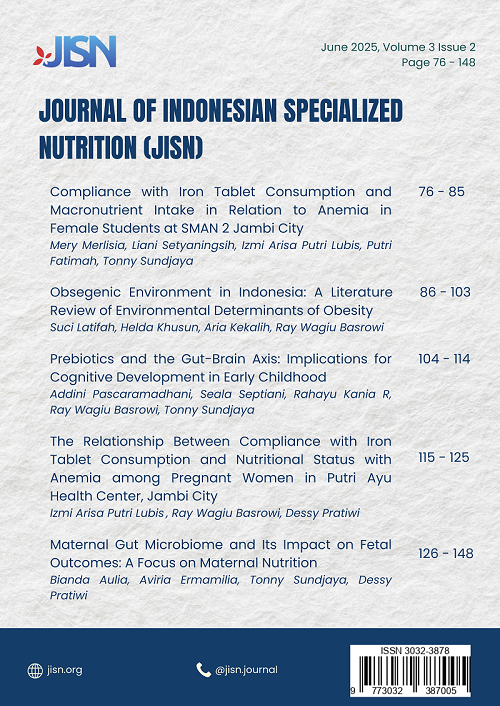
MATERNAL GUT MICROBIOME AND ITS IMPACT ON FETAL OUTCOMES: A FOCUS ON MATERNAL NUTRITION
DOI:
https://doi.org/10.63953/jisn.v3i2.46Keywords:
Gut microbiota, pregnancy, fetal nutrition, maternal diet, dysbiosisAbstract
Background: During pregnancy, maternal microbiota transfer and modifiable factors such as diet may contribute to fetal development. This review aims to clarify how maternal gut microbiota and diet interact to influence fetal nutrition and long-term health outcomes. Methods: A literature review was conducted on PubMed, Scopus, and Google Scholar. The search focused on studies investigating the links between maternal gut microbiota composition, dietary patterns, microbial metabolites, and fetal nutrition outcomes. Keywords included “pregnancy”, “gut microbiota”, “nutrition”, “maternal diet”, and “fetal growth”. Results: The maternal gut microbiota undergoes notable changes in late pregnancy, and its composition can be further influenced by external factors. Maternal diet and microbial transfer may impact fetal immune, metabolic, and neurodevelopment processes. Short-chain fatty acids and trimethylamine N-oxide are among key microbial metabolites implicated in fetal development. Although probiotic and prebiotic interventions during pregnancy show promise, current evidence remains limited and inconsistent across populations. Conclusion: Optimizing maternal gut microbiota through diet may support fetal nutrition and developmental outcomes. However, more longitudinal and ethnically diverse studies are needed.
References
de Vos WM, Tilg H, Van Hul M, Cani PD. Gut microbiome and health: mechanistic insights. Gut. 2022;71(5):1020-32. https://doi.org/10.1136/gutjnl-2021-326789.
Caprara GL, von Ameln Lovison O, Martins AF, Bernardi JR, Goldani MZ. Gut microbiota transfer evidence from mother to newborn. European Journal of Pediatrics. 2024;183(2):749-57. https://doi.org/10.1007/s00431-023-05341-1.
Ronde E, Alkema M, Dierikx T, Schoenmakers S, Belzer C, de Meij T. The influence of maternal gut and vaginal microbiota on gastrointestinal colonization of neonates born vaginally and per caesarean section. BMC Pregnancy and Childbirth. 2025;25(1):254. https://doi.org/10.1186/s12884-025-07358-w.
Sinha T, Brushett S, Prins J, Zhernakova A. The maternal gut microbiome during pregnancy and its role in maternal and infant health. Current Opinion in Microbiology. 2023;74:102309. https://doi.org/10.1016/j.mib.2023.102309.
Nyangahu DD, Jaspan HB. Influence of maternal microbiota during pregnancy on infant immunity. Clinical and Experimental Immunology. 2019;198(1):47-56. https://doi.org/10.1111/cei.13331.
Dawson SL, O'Hely M, Jacka FN, Ponsonby A-L, Symeonides C, Loughman A, et al. Maternal prenatal gut microbiota composition predicts child behaviour. eBioMedicine. 2021;68. https://doi.org/10.1016/j.ebiom.2021.103400.
Kartjito MS, Yosia M, Wasito E, Soloan G, Agussalim AF, Basrowi RW. Defining the Relationship of Gut Microbiota, Immunity, and Cognition in Early Life—A Narrative Review. Nutrients. 2023;15(12):2642.
Di Simone N, Santamaria Ortiz A, Specchia M, Tersigni C, Villa P, Gasbarrini A, et al. Recent Insights on the Maternal Microbiota: Impact on Pregnancy Outcomes. Front Immunol. 2020;Volume 11 - 2020. https://doi.org/10.3389/fimmu.2020.528202.
Chandra M, Paray AA. Natural Physiological Changes During Pregnancy. Yale J Biol Med. 2024;97(1):85-92. https://doi.org/10.59249/jtiv4138.
Peng Y, Tun HM, Ng SC, Wai HK-F, Zhang X, Parks J, et al. Maternal smoking during pregnancy increases the risk of gut microbiome-associated childhood overweight and obesity. Gut Microbes. 2024;16(1):2323234.
Thomas KL, Wahlquist AE, James D, Clark WA, Wagner CL. Effects of Maternal Pre-Pregnancy BMI on Preterm Infant Microbiome and Fecal Fermentation Profile—A Preliminary Cohort Study. Nutrients. 2025;17(6):987.
Rajasekera TA, Galley JD, Mackos AR, Chen HJ, Mitchell JG, Kleinman JJ, et al. Stress and depression-associated shifts in gut microbiota: A pilot study of human pregnancy. Brain, Behavior, & Immunity - Health. 2024;36:100730. https://doi.org/10.1016/j.bbih.2024.100730.
Zakaria ZZ, Al-Rumaihi S, Al-Absi RS, Farah H, Elamin M, Nader R, et al. Physiological changes and interactions between microbiome and the host during pregnancy. Frontiers in Cellular and Infection Microbiology. 2022;12:824925.
Weissgerber TL, Wolfe LA. Physiological adaptation in early human pregnancy: adaptation to balance maternal-fetal demands. Applied physiology, nutrition, and metabolism. 2006;31(1):1-11.
Mor G, Cardenas I. The immune system in pregnancy: a unique complexity. Am J Reprod Immunol. 2010;63(6):425-33. https://doi.org/10.1111/j.1600-0897.2010.00836.x.
Lain KY, Catalano PM. Metabolic changes in pregnancy. Clin Obstet Gynecol. 2007;50(4):938-48. https://doi.org/10.1097/GRF.0b013e31815a5494.
Bhatia Z, Kumar S, Seshadri S. Composition and interaction of maternal microbiota with immune mediators during pregnancy and their outcome: A narrative review. Life Sciences. 2024;340:122440. https://doi.org/10.1016/j.lfs.2024.122440.
Koren O, Goodrich JK, Cullender TC, Spor A, Laitinen K, Bäckhed HK, et al. Host remodeling of the gut microbiome and metabolic changes during pregnancy. Cell. 2012;150(3):470-80.
Smid MC, Ricks NM, Panzer A, McCoy AN, Azcarate-Peril MA, Keku TO, et al. Maternal Gut Microbiome Biodiversity in Pregnancy. Am J Perinatol. 2018;35(1):24-30. https://doi.org/10.1055/s-0037-1604412.
Nuriel-Ohayon M, Neuman H, Ziv O, Belogolovski A, Barsheshet Y, Bloch N, et al. Progesterone Increases Bifidobacterium Relative Abundance during Late Pregnancy. Cell Rep. 2019;27(3):730-6.e3. https://doi.org/10.1016/j.celrep.2019.03.075.
Shen W, Chen Q, Lin R, Hu Z, Luo M, Ren Y, et al. Imbalance of gut microbiota in gestational diabetes. BMC Pregnancy and Childbirth. 2024;24(1):226. https://doi.org/10.1186/s12884-024-06423-0.
Barrientos G, Ronchi F, Conrad ML. Nutrition during pregnancy: Influence on the gut microbiome and fetal development. American Journal of Reproductive Immunology. 2024;91(1):e13802. https://doi.org/10.1111/aji.13802.
Li R, Kurilshikov A, Yang S, van Oortmerssen JAE, van Hilten A, Ahmadizar F, et al. Association between gut microbiome profiles and host metabolic health across the life course: a population-based study. The Lancet Regional Health – Europe. 2025;50. https://doi.org/10.1016/j.lanepe.2024.101195.
Hrncir T. Gut Microbiota Dysbiosis: Triggers, Consequences, Diagnostic and Therapeutic Options. Microorganisms. 2022;10(3). https://doi.org/10.3390/microorganisms10030578.
Tian Z, Zhang X, Yao G, Jin J, Zhang T, Sun C, et al. Intestinal flora and pregnancy complications: Current insights and future prospects. Imeta. 2024;3(2):e167. https://doi.org/10.1002/imt2.167.
Hayward L, Watkins J, Bautista B, Lin C, Malphurs W, Zubcevic J. Nicotine exposure during pregnancy alters the maternal gut microbiome and both cecal and plasma short chain fatty acids in Sprague Dawley rats. The FASEB Journal. 2020;34(S1):1-.
Barrett HL, Gomez-Arango LF, Wilkinson SA, McIntyre HD, Callaway LK, Morrison M, et al. A Vegetarian Diet Is a Major Determinant of Gut Microbiota Composition in Early Pregnancy. Nutrients. 2018;10(7):890.
Ruebel ML, Gilley SP, Sims CR, Zhong Y, Turner D, Chintapalli SV, et al. Associations between Maternal Diet, Body Composition and Gut Microbial Ecology in Pregnancy. Nutrients. 2021;13(9):3295.
De Filippis F, Pasolli E, Tett A, Tarallo S, Naccarati A, De Angelis M, et al. Distinct Genetic and Functional Traits of Human Intestinal Prevotella copri Strains Are Associated with Different Habitual Diets. Cell Host & Microbe. 2019;25(3):444-53.e3. https://doi.org/10.1016/j.chom.2019.01.004.
Selma-Royo M, García-Mantrana I, Calatayud M, Parra-Llorca A, Martínez-Costa C, Collado MC. Maternal diet during pregnancy and intestinal markers are associated with early gut microbiota. European journal of nutrition. 2021;60:1429-42.
Rinninella E, Tohumcu E, Raoul P, Fiorani M, Cintoni M, Mele MC, et al. The role of diet in shaping human gut microbiota. Best Practice & Research Clinical Gastroenterology. 2023;62-63:101828. https://doi.org/10.1016/j.bpg.2023.101828.
Ilyés T, Silaghi CN, Crăciun AM. Diet-Related Changes of Short-Chain Fatty Acids in Blood and Feces in Obesity and Metabolic Syndrome. Biology (Basel). 2022;11(11). https://doi.org/10.3390/biology11111556.
Miller CB, Benny P, Riel J, Boushey C, Perez R, Khadka V, et al. Adherence to Mediterranean diet impacts gastrointestinal microbial diversity throughout pregnancy. BMC Pregnancy and Childbirth. 2021;21:1-14.
Laitinen K, Mokkala K. Overall Dietary Quality Relates to Gut Microbiota Diversity and Abundance. Int J Mol Sci. 2019;20(8). https://doi.org/10.3390/ijms20081835.
Röytiö H, Mokkala K, Vahlberg T, Laitinen K. Dietary intake of fat and fibre according to reference values relates to higher gut microbiota richness in overweight pregnant women. Br J Nutr. 2017;118(5):343-52. https://doi.org/10.1017/s0007114517002100.
Gow ML, Chua XY, El-Omar E, Susic D, Henry A. Relationship between Diet Quality and Maternal Stool Microbiota in the MUMS Australian Pregnancy Cohort. Nutrients. 2023;15(3). https://doi.org/10.3390/nu15030689.
Qin X, Zhang M, Chen S, Tang Y, Cui J, Ding G. Short-chain fatty acids in fetal development and metabolism. Trends in Molecular Medicine. 2024. https://doi.org/10.1016/j.molmed.2024.11.014.
Aye IL, Lager S, Ramirez VI, Gaccioli F, Dudley DJ, Jansson T, et al. Increasing maternal body mass index is associated with systemic inflammation in the mother and the activation of distinct placental inflammatory pathways. Biol Reprod. 2014;90(6):129. https://doi.org/10.1095/biolreprod.113.116186.
Poston L, Harthoorn LF, van der Beek EM, On Behalf of Contributors To The IEW. Obesity in Pregnancy: Implications for the Mother and Lifelong Health of the Child. A Consensus Statement. Pediatric Research. 2011;69(2):175-80. https://doi.org/10.1203/PDR.0b013e3182055ede.
Ermamilia A, Yonika L, Aulia B, Ganap EP. High Prepregnancy Body Mass Index and Excessive Gestational Weight Gain as Obesity-Related Risk Factors of Preeclampsia. Topics in Clinical Nutrition. 2020;35(4):299-308.
Torloni MR, Betrán AP, Horta BL, Nakamura MU, Atallah AN, Moron AF, et al. Prepregnancy BMI and the risk of gestational diabetes: a systematic review of the literature with meta-analysis. Obes Rev. 2009;10(2):194-203. https://doi.org/10.1111/j.1467-789X.2008.00541.x.
Mohr AE, Crawford Ms, Jasbi P, Fessler S, Sweazea KL. Lipopolysaccharide and the gut microbiota: considering structural variation. FEBS Letters. 2022;596(7):849-75. https://doi.org/10.1002/1873-3468.14328.
Collado MC, Isolauri E, Laitinen K, Salminen S. Distinct composition of gut microbiota during pregnancy in overweight and normal-weight women. Am J Clin Nutr. 2008;88(4):894-9. https://doi.org/10.1093/ajcn/88.4.894.
Santacruz A, Collado MC, García-Valdés L, Segura MT, Martín-Lagos JA, Anjos T, et al. Gut microbiota composition is associated with body weight, weight gain and biochemical parameters in pregnant women. Br J Nutr. 2010;104(1):83-92. https://doi.org/10.1017/s0007114510000176.
Leylabadlo HE, Ghotaslou R, Feizabadi MM, Farajnia S, Moaddab SY, Ganbarov K, et al. The critical role of Faecalibacterium prausnitzii in human health: An overview. Microb Pathog. 2020;149:104344. https://doi.org/10.1016/j.micpath.2020.104344.
Huang L, Cai M, Li L, Zhang X, Xu Y, Xiao J, et al. Gut microbiota changes in preeclampsia, abnormal placental growth and healthy pregnant women. BMC microbiology. 2021;21:1-9.
Tilves C, Yeh HC, Maruthur N, Juraschek SP, Miller E, White K, et al. Increases in circulating and fecal butyrate are associated with reduced blood pressure and hypertension: results from the SPIRIT trial. Journal of the American Heart Association. 2022;11(13):e024763.
Gomez-Arango LF, Barrett HL, McIntyre HD, Callaway LK, Morrison M, Dekker Nitert M. Increased systolic and diastolic blood pressure is associated with altered gut microbiota composition and butyrate production in early pregnancy. Hypertension. 2016;68(4):974-81.
Aagaard K, Ma J, Antony KM, Ganu R, Petrosino J, Versalovic J. The placenta harbors a unique microbiome. Sci Transl Med. 2014;6(237):237ra65. https://doi.org/10.1126/scitranslmed.3008599.
Ruiz-Triviño J, Álvarez D, Cadavid JÁ, Alvarez AM. From gut to placenta: understanding how the maternal microbiome models life-long conditions. Front Endocrinol (Lausanne). 2023;14:1304727. https://doi.org/10.3389/fendo.2023.1304727.
Ferretti P, Pasolli E, Tett A, Asnicar F, Gorfer V, Fedi S, et al. Mother-to-Infant Microbial Transmission from Different Body Sites Shapes the Developing Infant Gut Microbiome. Cell Host & Microbe. 2018;24(1):133-45.e5. https://doi.org/10.1016/j.chom.2018.06.005.
Li W, Tapiainen T, Brinkac L, Lorenzi HA, Moncera K, Tejesvi MV, et al. Vertical Transmission of Gut Microbiome and Antimicrobial Resistance Genes in Infants Exposed to Antibiotics at Birth. J Infect Dis. 2021;224(7):1236-46. https://doi.org/10.1093/infdis/jiaa155.
He Q, Lai-Yu K, Xiaoxia X, Zhi Z, Teng M, Haiyan X, et al. The meconium microbiota shares more features with the amniotic fluid microbiota than the maternal fecal and vaginal microbiota. Gut Microbes. 2020;12(1):1794266. https://doi.org/10.1080/19490976.2020.1794266.
Yang L, Sakandar HA, Sun Z, Zhang H. Recent advances of intestinal microbiota transmission from mother to infant. Journal of Functional Foods. 2021;87:104719. https://doi.org/10.1016/j.jff.2021.104719.
Xu H, Feng P, Sun Y, Wu D, Wang D, Wu L, et al. Plasma trimethylamine N-oxide metabolites in the second trimester predict the risk of hypertensive disorders of pregnancy: a nested case-control study. Hypertension Research. 2024;47(3):778-89. https://doi.org/10.1038/s41440-023-01563-w.
Wen Y, Peng L, Xu R, Zang N, Huang Q, Zhong M. Maternal serum trimethylamine-N-oxide is significantly increased in cases with established preeclampsia. Pregnancy Hypertension. 2019;15:114-7. https://doi.org/10.1016/j.preghy.2018.12.001.
Gilbert SF, Bosch TCG, Ledón-Rettig C. Eco-Evo-Devo: developmental symbiosis and developmental plasticity as evolutionary agents. Nature Reviews Genetics. 2015;16(10):611-22. https://doi.org/10.1038/nrg3982.
Lundgren SN, Madan JC, Emond JA, Morrison HG, Christensen BC, Karagas MR, et al. Maternal diet during pregnancy is related with the infant stool microbiome in a delivery mode-dependent manner. Microbiome. 2018;6(1):109. https://doi.org/10.1186/s40168-018-0490-8.
Chu DM, Antony KM, Ma J, Prince AL, Showalter L, Moller M, et al. The early infant gut microbiome varies in association with a maternal high-fat diet. Genome Medicine. 2016;8(1):77. https://doi.org/10.1186/s13073-016-0330-z.
Michel C, Blottière HM. Neonatal Programming of Microbiota Composition: A Plausible Idea That Is Not Supported by the Evidence. Frontiers in Microbiology. 2022;Volume 13 - 2022. https://doi.org/10.3389/fmicb.2022.825942.
Lange NE, Celedón JC, Forno E, Ly NP, Onderdonk A, Bry L, et al. Maternal intestinal flora and wheeze in early childhood. Clinical & Experimental Allergy. 2012;42(6):901-8. https://doi.org/10.1111/j.1365-2222.2011.03950.x.
Thorburn AN, McKenzie CI, Shen S, Stanley D, Macia L, Mason LJ, et al. Evidence that asthma is a developmental origin disease influenced by maternal diet and bacterial metabolites. Nature Communications. 2015;6(1):7320. https://doi.org/10.1038/ncomms8320.
Yuan G, Wen S, Zhong X, Yang X, Xie L, Wu X, et al. Inulin alleviates offspring asthma by altering maternal intestinal microbiome composition to increase short-chain fatty acids. PLOS ONE. 2023;18(4):e0283105. https://doi.org/10.1371/journal.pone.0283105.
Sajdel-Sulkowska EM. The Impact of Maternal Gut Microbiota during Pregnancy on Fetal Gut-Brain Axis Development and Life-Long Health Outcomes. Microorganisms. 2023;11(9). https://doi.org/10.3390/microorganisms11092199.
Mandal S, Godfrey KM, McDonald D, Treuren WV, Bjørnholt JV, Midtvedt T, et al. Fat and vitamin intakes during pregnancy have stronger relations with a pro-inflammatory maternal microbiota than does carbohydrate intake. Microbiome. 2016;4(1):55. https://doi.org/10.1186/s40168-016-0200-3.
Kartjito MS, Umam AF. Probiotics and Synbiotics as Potential Biotics in Gut Health-Promoting Nutrition. Journal of Indonesian Specialized Nutrition. 2024;2(1):29-36.
Muaris HJ, Kartjito MS, Salsabila IN. The Benefit of Diverse Fibre Prebiotics for Gut Health and Growth & Development. Journal of Indonesian Specialized Nutrition. 2024;2(4):1-8.
Movaghar R, Abbasalizadeh S, Vazifekhah S, Farshbaf-Khalili A, Shahnazi M. The effects of synbiotic supplementation on blood pressure and other maternal outcomes in pregnant mothers with mild preeclampsia: a triple-blinded randomized controlled trial. BMC Women's Health. 2024;24(1):80.
Chua MC, Ben-Amor K, Lay C, Neo AGE, Chiang WC, Rao R, et al. Effect of Synbiotic on the Gut Microbiota of Cesarean Delivered Infants: A Randomized, Double-blind, Multicenter Study. J Pediatr Gastroenterol Nutr. 2017;65(1):102-6. https://doi.org/10.1097/mpg.0000000000001623.
Kadim M, Masita BM. The importance of gut health in early life for long term health. World Nutrition Journal. 2022;5(S2):1-8.
Gibson GR, Hutkins R, Sanders ME, Prescott SL, Reimer RA, Salminen SJ, et al. Expert consensus document: The International Scientific Association for Probiotics and Prebiotics (ISAPP) consensus statement on the definition and scope of prebiotics. Nature Reviews Gastroenterology & Hepatology. 2017;14(8):491-502. https://doi.org/10.1038/nrgastro.2017.75.
Hill C, Guarner F, Reid G, Gibson GR, Merenstein DJ, Pot B, et al. The International Scientific Association for Probiotics and Prebiotics consensus statement on the scope and appropriate use of the term probiotic. Nature Reviews Gastroenterology & Hepatology. 2014;11(8):506-14. https://doi.org/10.1038/nrgastro.2014.66.
Wu R, Luan J, Hu J, Li Z. Effect of probiotics on pregnancy outcomes in gestational diabetes: systematic review and meta-analysis. Arch Gynecol Obstet. 2024;310(2):769-81. https://doi.org/10.1007/s00404-023-07346-5.
Jiang L, Zhang L, Xia J, Cheng L, Chen G, Wang J, et al. Probiotics supplementation during pregnancy or infancy on multiple food allergies and gut microbiota: a systematic review and meta-analysis. Nutr Rev. 2025;83(2):e25-e41. https://doi.org/10.1093/nutrit/nuae024.
Alemu BK, Wu L, Azeze GG, Lau SL, Wang Y, Wang CC. Microbiota-targeted interventions and clinical implications for maternal-offspring health: An umbrella review of systematic reviews and meta-analyses of randomised controlled trials. J Glob Health. 2024;14:04177. https://doi.org/10.7189/jogh.14.04177.
Halkjær SI, de Knegt VE, Lo B, Nilas L, Cortes D, Pedersen AE, et al. Multistrain Probiotic Increases the Gut Microbiota Diversity in Obese Pregnant Women: Results from a Randomized, Double-Blind Placebo-Controlled Study. Current Developments in Nutrition. 2020;4(7). https://doi.org/10.1093/cdn/nzaa095.
Halkjaer SI, de Knegt VE, Kallemose T, Jensen JB, Cortes D, Gluud LL, et al. No effect of multi-strain probiotic supplementation on metabolic and inflammatory markers and newborn body composition in pregnant women with obesity: Results from a randomized, double-blind placebo-controlled study. Nutr Metab Cardiovasc Dis. 2023;33(12):2444-54. https://doi.org/10.1016/j.numecd.2023.07.030.
Poulios E, Pavlidou E, Papadopoulou SK, Rempetsioti K, Migdanis A, Mentzelou M, et al. Probiotics Supplementation during Pregnancy: Can They Exert Potential Beneficial Effects against Adverse Pregnancy Outcomes beyond Gestational Diabetes Mellitus? Biology (Basel). 2024;13(3). https://doi.org/10.3390/biology13030158.
Carpay NC, Kamphorst K, de Meij TGJ, Daams JG, Vlieger AM, van Elburg RM. Microbial effects of prebiotics, probiotics and synbiotics after Caesarean section or exposure to antibiotics in the first week of life: A systematic review. PLoS One. 2022;17(11):e0277405. https://doi.org/10.1371/journal.pone.0277405.
Mallott EK, Sitarik AR, Leve LD, Cioffi C, Camargo CA, Jr., Hasegawa K, et al. Human microbiome variation associated with race and ethnicity emerges as early as 3 months of age. PLoS Biol. 2023;21(8):e3002230. https://doi.org/10.1371/journal.pbio.3002230.
Chen R, Duan Z-Y, Duan X-H, Chen Q-H, Zheng J. Progress in research on gut microbiota in ethnic minorities in China and consideration of intervention strategies based on ethnic medicine: A review. Frontiers in Cellular and Infection Microbiology. 2022;Volume 12 - 2022. https://doi.org/10.3389/fcimb.2022.1027541.
Dunlop AL, Knight AK, Satten GA, Cutler AJ, Wright ML, Mitchell RM, et al. Stability of the vaginal, oral, and gut microbiota across pregnancy among African American women: the effect of socioeconomic status and antibiotic exposure. PeerJ. 2019;7:e8004. https://doi.org/10.7717/peerj.8004.
Rahayu ES, Utami T, Mariyatun M, Hasan PN, Kamil RZ, Setyawan RH, et al. Gut microbiota profile in healthy Indonesians. World J Gastroenterol. 2019;25(12):1478-91. https://doi.org/10.3748/wjg.v25.i12.1478.
Prasoodanan PKV, Sharma AK, Mahajan S, Dhakan DB, Maji A, Scaria J, et al. Western and non-western gut microbiomes reveal new roles of Prevotella in carbohydrate metabolism and mouth-gut axis. NPJ Biofilms Microbiomes. 2021;7(1):77. https://doi.org/10.1038/s41522-021-00248-x.
Downloads
Published
Issue
Section
License
Copyright (c) 2025 Bianda Aulia, Aviria Ermamilia, Tonny Sundjaya, Dessy Pratiwi

This work is licensed under a Creative Commons Attribution-ShareAlike 4.0 International License.
Authors retain copyright and grant the journal the right of first publication with the work simultaneously licensed under a Creative Commons Attribution-ShareAlike 4.0 International (CC-BY-SA) that allows others to share the work with an acknowledgment of the work's authorship and initial publication in this journal.
Authors are able to enter into separate, additional contractual arrangements for the non-exclusive distribution of the journal's published version of the work (e.g., post it to an institutional repository or publish it in a book), with an acknowledgment of its initial publication in this journal.
Authors are permitted and encouraged to post their work online (e.g., in institutional repositories or on their website) prior to and during the submission process, as it can lead to productive exchanges, as well as earlier and greater citation of published work.
LICENSE TO PUBLISH
- All material published by the Journal of Indonesian Specialized Nutrition is protected under International copyright and intellectual property laws. Journal of Indonesian Specialized Nutrition is licensed under a Creative Commons Attribution-ShareAlike 4.0 International (CC-BY-SA) or an equivalent license as the optimal license for the publication, distribution, use, and reuse of scholarly works.
- This license permits anyone to compose, repair, and make derivative creations even for commercial purposes, as long as appropriate credit and proper acknowledgment of the original publication from a journal are made to allow users to trace back to the original manuscript and author.
- You must give appropriate credit, provide a link to the license, and indicate if changes were made. You may do so in any reasonable manner, but not in any way that suggests the licensor endorses you or your use. If you remix, transform or build upon the material, you must distribute your contributions under the same license as the original.