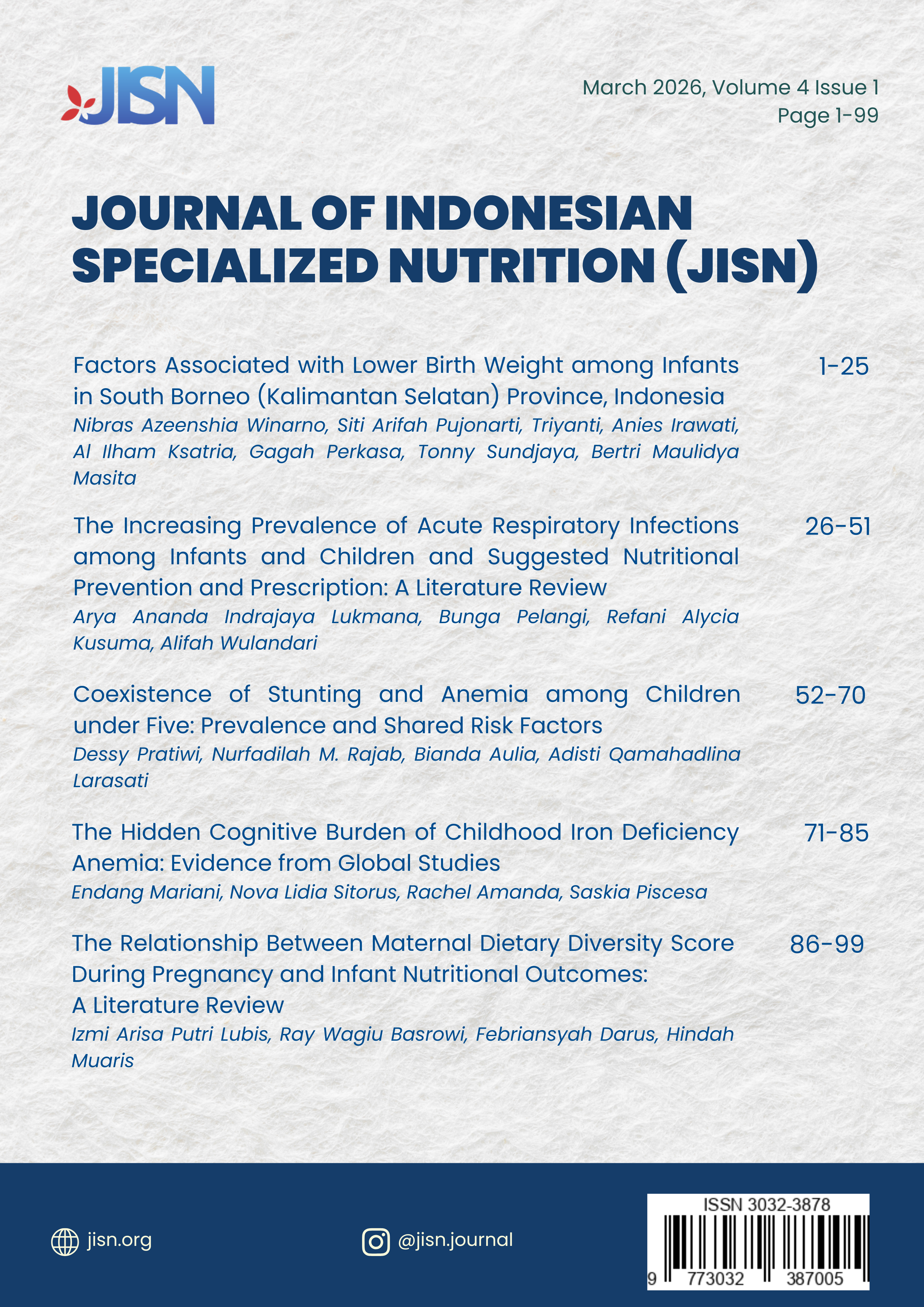
FACTORS ASSOCIATED WITH LOWER BIRTH WEIGHT AMONG INFANTS IN SOUTH KALIMANTAN PROVINCE, INDONESIA
DOI:
https://doi.org/10.63953/jisn.v4i1.70Keywords:
Birth weight, South Kalimantan, Chronic Energy Deficiency, thrifty phenotypeAbstract
Background: According to the thrifty phenotype hypothesis, individuals who have a Birth Weight less than 3000 grams are at risk of suffering from metabolic syndrome and type 2 diabetes mellitus in adulthood. The prevalence of Diabetes Mellitus and metabolic syndrome in Indonesia and South Kalimantan is increasing. In 2023, the Indonesian Health Survey (Survey Kesehatan Indonesia /SKI) data showed that the percentage of Birth Weight less than 3000 grams in Indonesia reached 35.3% and in South Kalimantan 41.7%. This indicates an increase in the percentage of Birth Weight less than 3000 grams in South Kalimantan when compared to the 2018 Riskesdas data, the percentage of BW less than 3000 grams in South Kalimantan was 37.5%. This is a quantitative study using a cross-sectional research design and using secondary data from the SKI 2023. Data were analyzed univariately and bivariately with complex samples and chi square tests. The results of the study found a significant association between Birth Weight and Chronic Energy Deficiency (p-value = 0.001) where mothers with a history of Chronic Energy Deficiency had a 5 times higher risk. Conclusion: History of Chronic Energy Deficiency among mothers is an important determinant of infants’ Birth Weight in South Kalimantan. Further, these findings might contribute to the prevention strategy of Non-Communicable Diseases in South Kalimantan.
Downloads
Published
Issue
Section
License
Copyright (c) 2026 Nibras Azeenshia Winarno, Siti Arifah Pujonarti, Triyanti Triyanti, Anies Irawati, Al Ilham Ksatria Gagah Perkasa, Tonny Sundjaya, Bertri Maulidya Masita

This work is licensed under a Creative Commons Attribution-ShareAlike 4.0 International License.
Authors retain copyright and grant the journal the right of first publication with the work simultaneously licensed under a Creative Commons Attribution-ShareAlike 4.0 International (CC-BY-SA) that allows others to share the work with an acknowledgment of the work's authorship and initial publication in this journal.
Authors are able to enter into separate, additional contractual arrangements for the non-exclusive distribution of the journal's published version of the work (e.g., post it to an institutional repository or publish it in a book), with an acknowledgment of its initial publication in this journal.
Authors are permitted and encouraged to post their work online (e.g., in institutional repositories or on their website) prior to and during the submission process, as it can lead to productive exchanges, as well as earlier and greater citation of published work.
LICENSE TO PUBLISH
- All material published by the Journal of Indonesian Specialized Nutrition is protected under International copyright and intellectual property laws. Journal of Indonesian Specialized Nutrition is licensed under a Creative Commons Attribution-ShareAlike 4.0 International (CC-BY-SA) or an equivalent license as the optimal license for the publication, distribution, use, and reuse of scholarly works.
- This license permits anyone to compose, repair, and make derivative creations even for commercial purposes, as long as appropriate credit and proper acknowledgment of the original publication from a journal are made to allow users to trace back to the original manuscript and author.
- You must give appropriate credit, provide a link to the license, and indicate if changes were made. You may do so in any reasonable manner, but not in any way that suggests the licensor endorses you or your use. If you remix, transform or build upon the material, you must distribute your contributions under the same license as the original.