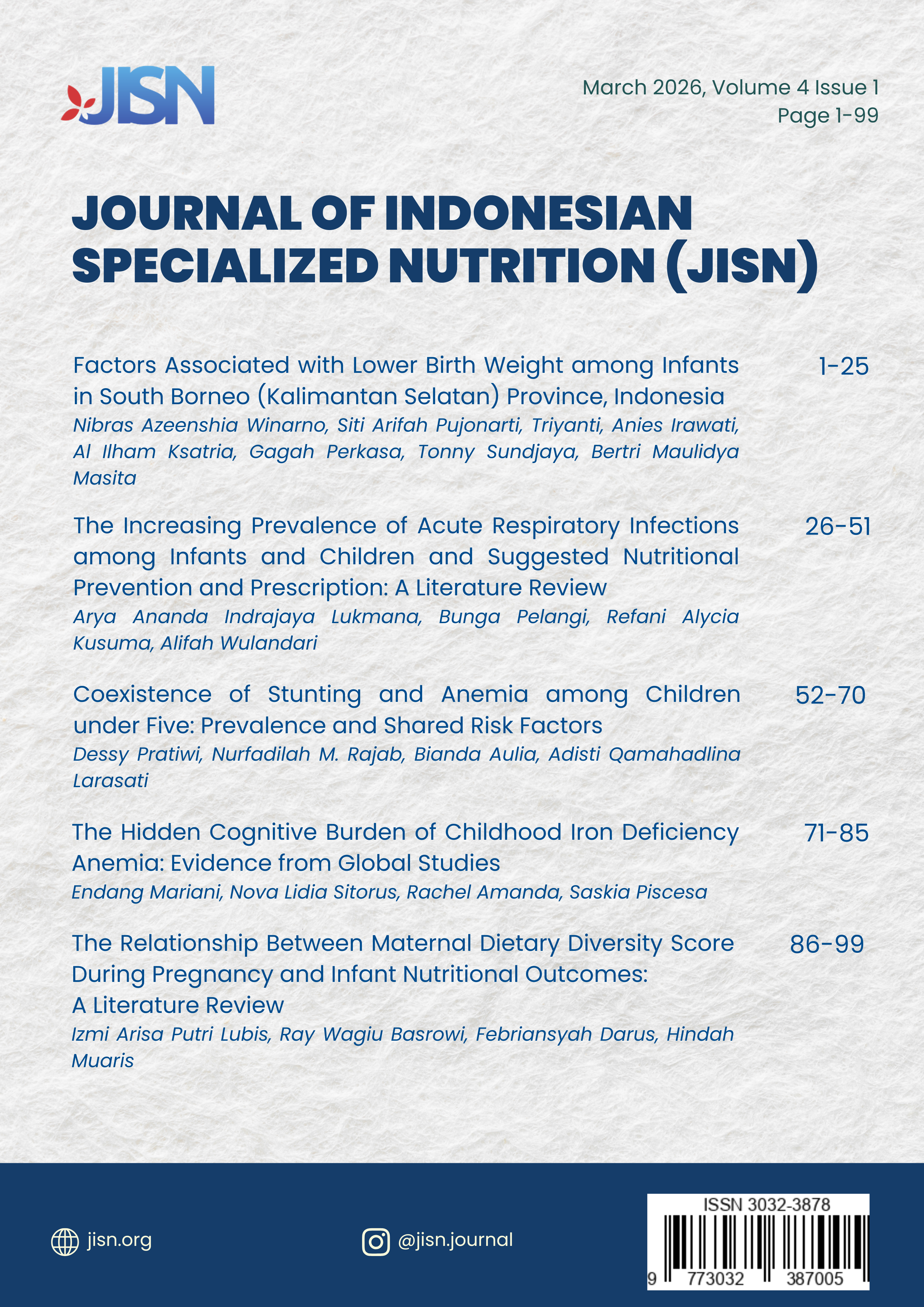
THE RELATIONSHIP BETWEEN MATERNAL DIETARY DIVERSITY SCORE DURING PREGNANCY AND INFANT NUTRITIONAL OUTCOMES: A LITERATURE REVIEW
DOI:
https://doi.org/10.63953/jisn.v4i1.71Keywords:
Maternal dietary diversity, Birth weight, Infant outcomes, Pregnancy nutritionAbstract
Background: Maternal nutrition during pregnancy is crucial for fetal development and long-term infant health. Dietary diversity is commonly used as an indicator of diet quality, reflecting the adequacy of macro-and micronutrient intake. This study aimed to examine the association between the Maternal Dietary Diversity Score (MDDS) during pregnancy and infant health outcomes.Methods:This study was a systematic literature review of 11articles. This article wassourced from scientific journal articles on Google Scholar, ScienceDirect, and PubMed for original observational studies published between 2015 and 2025.Results:The majority of research was carried out utilizing cohort, cross-sectional, or case-control designs in developing nations in Asia and Africa. Research continuously shows that a more varied diet for mothers is linked to better birth outcomes, especially higher birth weight and a lower chance of low birth weight (LBW). Additionally, a number of studies found that babies born to mothers who varied their diets were less likely to have low birth weights. Conclusions:MDDS is crucial for preventing LBWand supporting the baby's long-term growth and immunity. The quality of food choices and focused nutrition education are equally as important as the quantity of food groups
References
Dassie GA, Lemi H, Getachew T, Ayana S. Maternal diet quality during pregnancy and birth outcomes in low- and middle-income countries: a scoping review. BMC Nutr. 2026 Jan;
Rosmalina Y, Luciasari E. Besaran Keragaman dan Kualitas Konsumsi Bahan Makanan pada Ibu Hamil di Indonesia (The Quality And Food Diversity Of Pregnant Women In Indonesia). Nutr Food Res. 2016;39(1):65–73.
Islam H, Nayan M, Jubayer A, Amin R. A review of the dietary diversity and micronutrient adequacy among the women of reproductive age in low- and middle- income countries. 2024;(October 2023):1367–79.
Javadi M, Saffari F, Amerzadeh M, Rafiei S. Maternal dietary diversity and its association with infant birth weight : a healthcare centre based cross ‑ sectional study. Discov Public Heal [Internet]. 2024; Available from: https://doi.org/10.1186/s12982-024-00153-6
Abubakari A, Jahn A. Maternal Dietary Patterns and Practices and Birth Weight in Northern Ghana. 2016;1–17.
Terfa ZG, Nantanda R, Lesosky M, Devereux G, Obasi A, Mortimer K, et al. Household food insecurity , maternal nutrition , environmental risks and infants ’ health outcomes : protocol of the IMPALA birth cohort study in Uganda. 2022;1–8.
Sharma S, Maheshwari S, Mehra S. Association between Maternal Dietary Diversity and Low Birth Weight in Central India : A Case-Control Study. 2021;2021.
Yedu D, Boateng D. Heliyon Maternal dietary diversity and pattern during pregnancy is associated with low infant birth weight in the Cape Coast metropolitan hospital , Ghana : A hospital based cross-sectional study. Heliyon [Internet]. 2020;6(5):e03923. Available from: https://doi.org/10.1016/j.heliyon.2020.e03923
Wondemagegn AT, Tsehay B, Mebiratie akiloge lake, Negesse A. Effects of dietary diversification during pregnancy on birth outcomes in east Gojjam , northwest Ethiopia : A prospective cohort study.
Yang J, Wang M, Tobias DK, Edwards JWR, Marie A, Ajibola D, et al. Dietary diversity and diet quality with gestational weight gain and adverse birth outcomes , results from a prospective pregnancy cohort study in urban Tanzania. 2021;(October 2021).
Aulia B, Ermamilia A, Sundjaya T, Pratiwi D, Mada UG, Health I. Maternal gut microbiome and its impact on fetal outcomes : a focus on maternal nutrition. 2025;03(02):125–46.
Al-hassan F, Lina Rodriguerz. Maternal Dietary Diversity and its Influence on Nutritional Status During Pregnancy and Infant Birth Weight Outcomes. 2025;02(05):1–5.
Madzorera I, Ghosh S, Wang M, Fawzi W, Isanaka S, Hertzmark E, et al. Prenatal dietary diversity may influence underweight in infants in a Ugandan birth-cohort. 2021;(December 2020):1–12.
Madzorera I, Isanaka S, Wang M, Msamanga GI, Urassa W, Hertzmark E. Maternal dietary diversity and dietary quality scores in relation to adverse birth outcomes in Tanzanian women. 2020;695–706.
Jung DK, Tan ST, Hemlock C, Mertens AN, Stewart CP, Rahman Z, et al. Micronutrient Status During Pregnancy is Associated with Child Immune Status in Rural Bangladesh. Curr Dev Nutr [Internet]. 2023;7(8):101969. Available from: https://doi.org/10.1016/j.cdnut.2023.101969
Basrowi RW, Darus F, Sundjaya T, Arumndari R. Maternal Nutrition: The Foundation of Breastfeeding and Beyond: Gizi Ibu: Fondasi Menyusui dan Masa Depan Anak. Amerta Nutr [Internet]. 2025 Nov 21;9(4 SE-Literature Review):735–46. Available from: https://e-journal.unair.ac.id/AMNT/article/view/67314
Beressa G, Whiting SJ, Belachew T. Effect of nutrition education integrating the health belief model and theory of planned behavior during pregnancy on gestational weight gain and birth weight in Southeast Ethiopia using complex analyses. BMC Pregnancy Childbirth [Internet]. 2025; Available from: https://doi.org/10.1186/s12884-025-07284-x
Downloads
Published
Issue
Section
License
Copyright (c) 2026 izmi arisa putri lubis, Ray Wagiu Basrowi, Febriansyah Darus, Hindah Muaris

This work is licensed under a Creative Commons Attribution-ShareAlike 4.0 International License.
Authors retain copyright and grant the journal the right of first publication with the work simultaneously licensed under a Creative Commons Attribution-ShareAlike 4.0 International (CC-BY-SA) that allows others to share the work with an acknowledgment of the work's authorship and initial publication in this journal.
Authors are able to enter into separate, additional contractual arrangements for the non-exclusive distribution of the journal's published version of the work (e.g., post it to an institutional repository or publish it in a book), with an acknowledgment of its initial publication in this journal.
Authors are permitted and encouraged to post their work online (e.g., in institutional repositories or on their website) prior to and during the submission process, as it can lead to productive exchanges, as well as earlier and greater citation of published work.
LICENSE TO PUBLISH
- All material published by the Journal of Indonesian Specialized Nutrition is protected under International copyright and intellectual property laws. Journal of Indonesian Specialized Nutrition is licensed under a Creative Commons Attribution-ShareAlike 4.0 International (CC-BY-SA) or an equivalent license as the optimal license for the publication, distribution, use, and reuse of scholarly works.
- This license permits anyone to compose, repair, and make derivative creations even for commercial purposes, as long as appropriate credit and proper acknowledgment of the original publication from a journal are made to allow users to trace back to the original manuscript and author.
- You must give appropriate credit, provide a link to the license, and indicate if changes were made. You may do so in any reasonable manner, but not in any way that suggests the licensor endorses you or your use. If you remix, transform or build upon the material, you must distribute your contributions under the same license as the original.