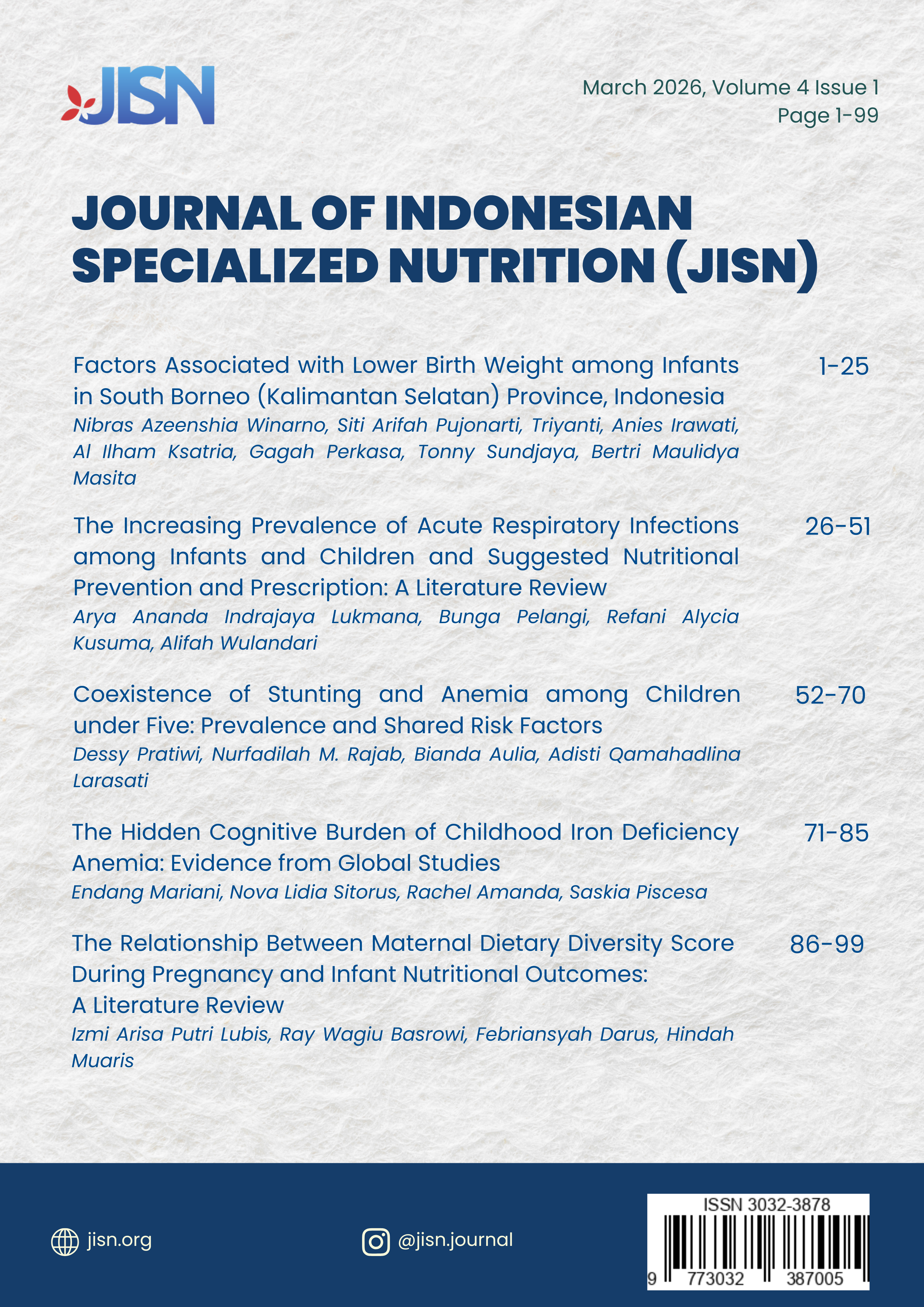
THE HIDDEN COGNITIVE BURDEN OF CHILDHOOD IRON DEFICIENCY ANEMIA: EVIDENCE FROM GLOBAL STUDIES
DOI:
https://doi.org/10.63953/jisn.v4i1.74Keywords:
anemia, children, pediatric, Iron deficiency, cognitive, child development, child nutritionAbstract
Introduction: Iron Deficiency Anemia (IDA) remains one of the most significant public health problems worldwide. Prior studies have shown associations between low iron status/iron deficiency anemia and poor child development outcomes. Studies suggested IDA among younger children may cause permanent cognitive and/or developmental disabilities. Methods:Literature search was conducted across PubMed, Scopus, and Google Scholar for studies published between2006 and 2025. Search terms included “anemia,” “children,” “pediatric,” “iron deficiency,” “cognitive,” “child development,” and “child nutrition.”Inclusion criteria of this review: pediatric populations (0–18 years), anemia-supplementation interventions, and outcomes related to nutrition, biochemical markers, or nutritional status. Fifteen core studies (RCTs, systematic reviews, meta-analyses, and narrative reviews) met all inclusion criteria. Results:The reviewed studies demonstrate that anemiain children, primarily due to iron deficiency, is associated with impaired cognitive and developmental outcomes. Iron deficiency affects brain development by disrupting oxygen delivery, myelination, and neurotransmitter function, particularly during early growthperiod in which it is critical. The biological effectis linked to deficits in attention, memory, learning performance, and school readiness. Based on the evidence,further suggests that these early impairments may persist into later educational and economic disadvantages, contributing to a profound long-term loss of human capital. Conclusion:Childhood anemia, especially IDA, is evidently associated with impaired cognitive and developmental outcomes. Early prevention, screening, and appropriate iron interventions are essential to protect neurodevelopment and support long-term human capital formation.
References
Sunardi D, Bardosono S, Basrowi RW, Wasito E, Vandenplas Y. Dietary Determinants of Anemia in Children Aged 6–36 Months: A Cross-Sectional Study in Indonesia. Nutrients. 2021. 13(7),2397. doi.org/10.3390/nu13072397
Kumari A, Obazenu LO, Monis M, Mustapha-Adebiyi HT, Wandala A, Venkata Harischandra T, et al. Association between iron deficiency without anemia and cognitive impairment in children. Cureus. 2025;17(7):e89049. doi:10.7759/cureus.89049.
Pivina L, Semenova Y, Doşa MD, Dauletiyarova M, Bjørklund G. Iron deficiency, cognitive functions, and neurobehavioral disorders in children. J Mol Neurosci. 2019;68:1–10. doi:10.1007/s12031-019-01276-1.
Helmyati S, Fauziah LA, Kadibyan P, Sitorus NL, Dilantika C. Relationship between anemia status, sleep quality, and cognitive ability among young women aged 15–24 years in Indonesia (analysis of Indonesian Family Life Survey). Amerta Nutr. 2023;7(3 Suppl):1–9. doi:10.20473/amnt.v7i3SP.2023.1-9.
Basrowi RW, Zulfiqqar A, Sitorus NL. Anemia in breastfeeding women and its impact on offspring’s health in Indonesia: a narrative review. Nutrients. 2024;16(9):1285. doi:10.3390/nu16091285.
Mamun MA, Ghani RBA. The role of iron and zinc in cognitive development of children. Asian J Med Biol Res. 2017;3(2):145–151. doi:10.3329/ajmbr.v3i2.33561.
World Health Organization (WHO). Malnutrition fact sheet. WHO News Room. 1 Mar 2024. Available from: https://www.who.int/en/news-room/fact-sheets/detail/malnutrition.
United Nations Children Fund; United Nations University; World Health Organization 2011. Iron Deficiency Anaemia Assessment, Prevention and Control: A guide for programme managers; WHO/NHD/01.3.
Benedict RK, Pullum TW, Riese S, Milner E. Is child anemia associated with early childhood development? A cross-sectional analysis of nine Demographic and Health Surveys. PLoS One. 2024;19(2):e0298967. doi:10.1371/journal.pone.0298967.
Zulfikar RRO, Mariani E, Gunawan C, Sitorus NL, Dilantika C, Sundjaya T, et al. Improving iron deficiency anemia (IDA) prevention and management strategies in Indonesia: an expert opinion. Open Public Health J. 2025 Jun 11. doi:10.2174/0118749445361508250602094137.
Gutema BT, Sorrie MB, Megersa ND, Yesera GE, Yeshitila YG, Yihun ML, et al. Effects of iron supplementation on cognitive development in school-age children: Systematic review and meta-analysis. PLoS One. 2023;18(6):e0287703. doi:10.1371/journal.pone.0287703.
Hua M, Shi D, Xu W, Zhu L, Hao X, Zhu B, et al. Differentiation between fetal and postnatal iron deficiency in altering brain substrates of cognitive control in pre-adolescence. BMC Med. 2023;21:167. doi:10.1186/s12916-023-02850-6.
Hod EA, Habeck C, Zhuang H, et al. (2025). Effects of iron repletion on brain iron content, myelination, neural network activation, and cognition. JCI Insight, 10(23), e194442. doi:10.1172/jci.insight.194442.
Gisslen T, Rao R, Georgieff MK. Anemia, iron supplementation, and the brain. Clin Perinatol. 2023;50(4):731–746. doi:10.1016/j.clp.2023.08.002.
McCann JC, Ames BN. An overview of evidence for a causal relation between iron deficiency during development and deficits in cognitive or behavioral function. Am J Clin Nutr. 2007;85(4):931–945.
Grantham-McGregor S, Cheung YB, Cueto S, Glewwe P, Richter L, Strupp B. Developmental potential in the first 5 years for children in developing countries. Lancet. 2021;397(10282):101–115. doi:10.1016/S0140-6736(20)61400-6.
Latifah S, Septiani S, Kusuma RA, Pratiwi D. Iron deficiency in early life and later behavioral outcomes: a systematic review. J Indones Spec Nutr. 2025;3(4). doi:10.63953/jisn.v3i4.67.
Black MM, Walker SP, Fernald LCH, Andersen CT, DiGirolamo AM, Lu C, et al. Early childhood development coming of age: science through the life course. Lancet. 2017;389(10064):77–90.
Falkingham M, Abdelhamid A, Curtis P, Fairweather-Tait S, Dye L, Hooper L. The effects of oral iron supplementation on cognition in older children and adults: a systematic review and meta-analysis. Nutr J. 2010;9:4.
Prima Maharani Putri PM, Shafira AS, Mahardhika GS. Stunting reduction strategy in Indonesia: Maternal Knowledge Aspects. The Indonesian J of Public Health,19(2), 329-343. https://doi.org/10.20473/Ijph.v19i2.2024.329-343.
Oktarina C, Dilantika C, Sitorus NL, Basrowi RW. Relationship between iron deficiency anemia and stunting in pediatric populations in developing countries: a systematic review and meta-analysis. Children (Basel). 2024;11(10):1268. doi:10.3390/children11101268.
Sekartini R, Widjaja NA, Manikam NRM, Jo J, Basrowi RW, Dilantika C. Iron-deficiency anemia: Indonesia’s striving. Asia Pac J Paediatr Child Health. 2022;5(4):[page numbers if available].
Sungkar A, Bardosono S, Irwinda R, Manikam NRM, Sekartini R, Medise BE, et al. A life course approach to the prevention of iron deficiency anemia in Indonesia. Nutrients. 2022;14(2):277. doi:10.3390/nu14020277.
Downloads
Published
Issue
Section
License
Copyright (c) 2026 Endang Mariani, Nova Lidia Sitorus, Rachel Amanda, Saskia Piscesa

This work is licensed under a Creative Commons Attribution-ShareAlike 4.0 International License.
Authors retain copyright and grant the journal the right of first publication with the work simultaneously licensed under a Creative Commons Attribution-ShareAlike 4.0 International (CC-BY-SA) that allows others to share the work with an acknowledgment of the work's authorship and initial publication in this journal.
Authors are able to enter into separate, additional contractual arrangements for the non-exclusive distribution of the journal's published version of the work (e.g., post it to an institutional repository or publish it in a book), with an acknowledgment of its initial publication in this journal.
Authors are permitted and encouraged to post their work online (e.g., in institutional repositories or on their website) prior to and during the submission process, as it can lead to productive exchanges, as well as earlier and greater citation of published work.
LICENSE TO PUBLISH
- All material published by the Journal of Indonesian Specialized Nutrition is protected under International copyright and intellectual property laws. Journal of Indonesian Specialized Nutrition is licensed under a Creative Commons Attribution-ShareAlike 4.0 International (CC-BY-SA) or an equivalent license as the optimal license for the publication, distribution, use, and reuse of scholarly works.
- This license permits anyone to compose, repair, and make derivative creations even for commercial purposes, as long as appropriate credit and proper acknowledgment of the original publication from a journal are made to allow users to trace back to the original manuscript and author.
- You must give appropriate credit, provide a link to the license, and indicate if changes were made. You may do so in any reasonable manner, but not in any way that suggests the licensor endorses you or your use. If you remix, transform or build upon the material, you must distribute your contributions under the same license as the original.