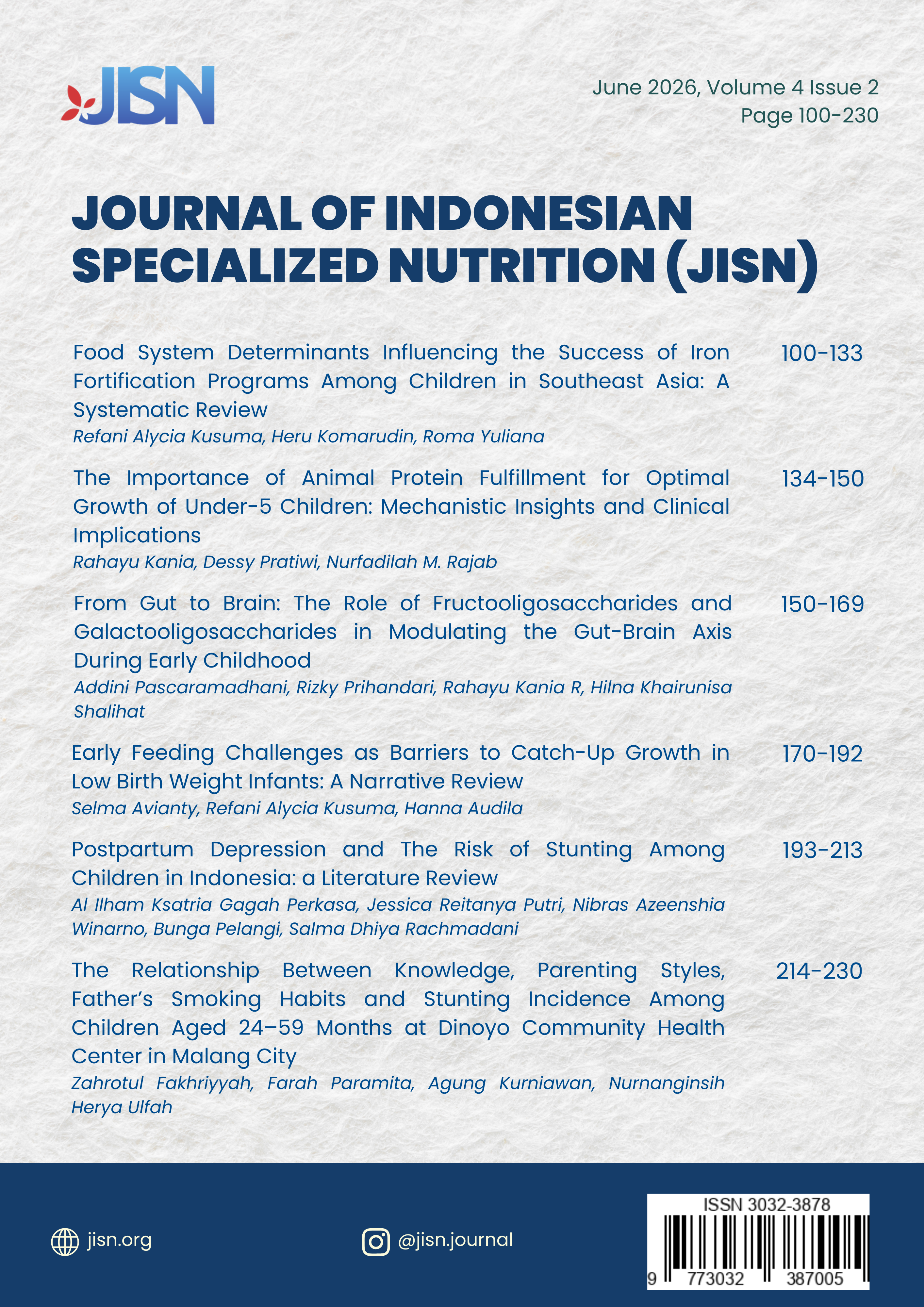
THE RELATIONSHIP BETWEEN KNOWLEDGE, PARENTING STYLES, FATHER’S SMOKING HABITS AND STUNTING INCIDENCE AMONG CHILDREN AGED 24–59 MONTHS AT DINOYO COMMUNITY HEALTH CENTER IN MALANG CITY
DOI:
https://doi.org/10.63953/jisn.v4i2.82Keywords:
Stunting, knowledge, parenting practices, father’s smoking habitsAbstract
Background: The latest data from 2024 shows that the stunting rate in Malang City has increased by 5.4%, with the Dinoyo Community Health Center reporting the highest prevalence among the 16 community health centers, at 15.3%. Stunting is a national priority health issue due to its long-term impact on children’s physical and cognitive development. Indirect factors such as parental knowledge, parenting styles, and fathers’ smoking habits also contribute to the occurrence of stunting. This study aims to analyze the relationship between these factors and the incidence of stunting at the Dinoyo Community Health Center in Malang City. Methods: This observational study employed a quantitative cross-sectional design involving 106 respondents selected through purposive sampling. Data were collected via anthropometric measurements and validated, reliable questionnaires, and analyzed using the chi-square test at a significance level of α = 0.05. Results: The results showed significant association between knowledge (P=0.004), parenting style (P=0.004), and the father’s smoking habits (P=0.025) with the prevalence of stunting. Conclusion: that the parenting style variable was the most significant risk factor for stunting, with an Odds Ratio (OR) of 3.9 (95% CI: 1.489–10.719). The conclusion of this study is that sensitive interventions focused on improving parenting practices—particularly regarding feeding practices, sanitation, and psychosocial stimulation—play a crucial role in the growth of infants and toddlers.
References
Aghadiati, F., Ardianto, O., & Wati, S. R. (2023). Relationship Between Mother’s Knowledge and Stunting Incidence in the Service Area of the Suhaid Health Center. In Journal of Healthcare Technology and Medicine (Vol. 9, No. 1).
Al-Haiban, U. W., & Gunarto, T. (2026). The Effect of Cigarette Consumption, Education Level, and Income on Calorie Intake in Lampung Province. Journal of Community Service and Educational Research, 4(3), 18892–18898. https://doi.org/10.31004/jerkin.v4i3.4953
Aliyati, N. N., & Mujiburrahman. (2024). Factors Influencing Mothers’ Knowledge of Stunting in Toddlers at the Rasanae Timur Community Health Center, Bima City. EKOMA: Journal of Economics, 3(2).
Angraini, W., Febriawati, H., & Amin, M. (2022). Access to Sanitary Toilets for Stunted Toddlers. Silampari Nursing Journal, 6(1), 117–123. https://doi.org/10.31539/jks.v6i1.4069
Arnita, S., Rahmadhani, D. Y., & Sari, M. T. (2020). The Relationship Between Mothers’ Knowledge and Attitudes and Stunting Prevention Efforts Among Toddlers in the Service Area of the Simpang Kawat Community Health Center, Jambi City. Jurnal Akademika Baiturrahim Jambi, 9(1), 7. https://doi.org/10.36565/jab.v9i1.149
Astuti, D. D., Handayani, T. W., & Astuti, D. P. (2020). Cigarette smoke exposure and increased risks of stunting among under-five children. Clinical Epidemiology and Global Health, 8(3), 943–948. https://doi.org/10.1016/j.cegh.2020.02.029
Bella, F. D., Fajar, N. A., & Misnaniarti. (2019). The Relationship Between Parenting Styles and the Incidence of Stunting in Toddlers from Low-Income Families in Palembang City. In The Indonesian Journal of Nutrition (Vol. 8, No. 1).
Bimantara, A. M. (2022). The Relationship Between Smoking Habits and the Incidence of Insomnia Among Adolescents at SMKN 1 Bendo Magetan.
Christiana, I., Nazmi, A. N., & Anisa, F. H. (2022). The Relationship Between Maternal Parenting Styles and the Prevalence of Stunting in Toddlers in Kertosari Village, Kertosari Public Health Center Service Area, Banyuwangi.
Dewi, N. W. E. P., & Ariani, N. K. S. (2021). The Relationship Between Mothers’ Nutritional Knowledge and Reduced Risk of Stunting in Toddlers in Gianyar Regency. Jurnal Menara Medika, 3(2). https://jurnal.umsb.ac.id/index.php/menaramedika/index
Dhiya, Habibi, U., Satiti, I. A. D., & Ramadhani, R. (2023). The Relationship Between Authoritarian Parenting Styles and Children’s Academic Achievement. In Media Husada Journal of Nursing Science (Vol. 4, No. 3). https://mhjns.widyagamahusada.ac.id
Effendy, A., Silahi, R. D., & Syahrias, L. (2026). The Relationship Between Family Smoking Behavior and the Incidence of Stunting in Toddlers in the Botania Community Health Center Service Area in 2025 (Vol. 16, No. 2). DOI. http://ejurnal.univbatam.ac.id/index.php/Keperawatan
Fauziyah, N. A., Rosidin, U., Purnama, D., Mardiah, W., Susanti, R. D., & Rahayuwati, L. (2023). The Relationship Between Parental Child-Rearing Practices and the Incidence of Stunting in Toddlers. Malahayati Nursing Journal, 5(5), 1412–1427. https://doi.org/10.33024/mnj.v5i5.8554
Fitri, Lailiyana, & Oktariani, F. (2024). Establishment of the “Smart Mothers for Healthy Children” Community for Stunting Prevention in Ranah Singkuang Village, Kampar Regency. PITIMAS: Journal of Community Engagement in Health.
Hasanah, U., Maria, I. L., Jafar, N., Hardianti, A., Mallongi, A., & Syam, A. (2020). Water, sanitation, and hygiene analysis, and individual factors for stunting among children under two years in Ambon. Open Access Macedonian Journal of Medical Sciences, 8(T2), 22–26. https://doi.org/10.3889/oamjms.2020.5177
Hasnawati, Latief, S., & AL, J. P. (2021). The Relationship Between Maternal Knowledge and the Incidence of Stunting in Toddlers Aged 12–59 Months. In Journal of Nursing and Midwifery Education (Vol. 01, No. 1).
Hayat, A. P. (2022). Perceptions of Parenting Styles Among Working and Non-Working Mothers: A Case Study in Gondokusuman, Yogyakarta City. Jurnal Pelita PAUD, 6(2), 310–320. https://doi.org/10.33222/pelitapaud.v6i2.1986
HM, K. D., Susaldi, & Munawaroh, M. (2024a). The Relationship Between Exposure to Secondhand Smoke, Dietary Patterns, and Medical History Factors with the Incidence of Stunting.
HM, K. D., Susaldi, & Munawaroh, M. (2024b). The Relationship Between Exposure to Cigarette Smoke, Dietary Patterns, and Medical History Factors with the Incidence of Stunting.Ministry of Health of the Republic of Indonesia. (2025). 2024 Indonesia Nutrition Status Survey.
Khofiyah, N. (2019). The relationship between nutritional status and feeding practices with the development of children aged 6–24 months. In Indonesian Journal of Midwifery Research (Vol. 3, No. 1).
Maharani, V., & Harsanti, T. (2017). Variables Affecting Smoking Intensity Among Male Adolescents in Indonesia in 2017.
Marbun, A. H., Badi’ah, A., & Maimunah, S. (2024). The Effect of Parenting Styles, Feeding Practices, and Maternal Nutritional Status During Pregnancy on the Incidence of Stunting in Toddlers Aged 12–59 Months.
Martony, O. (2023). Stunting in Indonesia: Challenges and Solutions in the Modern Era. Journal of Telenursing (JOTING), 5(2), 1734–1745. https://doi.org/10.31539/joting.v5i2.6930
Masrikhiyah, R. (2025). The Relationship Between Nutrition Knowledge Levels and the Adequacy of Macro-Nutrient Intake in Elementary School Children. http://ejournal.urindo.ac.id/index.php/kesehatan
Nurhidayat, S. (2018). The Relationship Between Smoking Frequency and the Incidence of Hypertension in the Community.
Prameswary, C. A., Masnadi, N. R., Adrial, Yulistini, & Nofita, E. (2025). Factors Associated with the Incidence of Stunting in Toddlers at the Anak Air Community Health Center. Indonesian Journal of Health Sciences, 6(3), 182–189. https://doi.org/10.25077/jikesi.v6i3.1316
Priyono. (2020). Strategies for Accelerating the Reduction of Rural Stunting (Case Study of Support for Stunting Prevention Actions in Banyumundu Village, Pandeglang Regency).
Puspita, S. D. (2023). The Relationship Between Maternal Child-rearing Practices and Dietary Diversity with the Incidence of Stunting in Toddlers in the Service Area of the Sungai Guntung Public Health Center (UPT Puskesmas) in Indragiri Hilir Regency.
Putri, A. A. Y., Roslita, R., & Adila, D. R. (2022). The Relationship Between Mothers’ Knowledge Levels Regarding Stunting and Stunting Prevention Efforts in Preschool-Aged Children. https://doi.org/10.25311/jkh.Vol2.Iss3.849
Putry, S. A. F. (2023). The Relationship Between Nutritional Knowledge, Illness Frequency, and Economic Status of Toddlers Aged 2–5 Years and the Incidence of Stunting in the Service Area of the Tanah Kali Kedinding Community Health Center.
Riski Nirmala Sari, M., & Yusi Ratnawati, L. (2018). The Relationship Between Mothers’ Knowledge of Feeding Practices and the Nutritional Status of Toddlers in the Service Area of the Gapura Public Health Center, Sumenep Regency. Amerta Nutr, 30–36. https://doi.org/10.2473/amnt.v2i2.2018.182-188
Sabtian, Y. T., Nashihah, D., & Soffi, D. A. (2023). Literature Review: A Map of Potential Strategies for Stunting Eradication in Malang City.
Sari, P., Sary, L., & Febriani, C. A. (2021). Community Awareness of Quitting Smoking in the Service Area of Penawar Jaya Community Health Center, Tulang Bawang District, in 2020. In Jurnal Dunia Kesmas (Vol. 96, No. 1). Online. http://ejurnalmalahayati.ac.id/index.php/duniakesmas/index
Silas, L., Rantetampang, A. L., Tingginehe, R., & Mallongi, A. (2018). Factors Affecting Stunting in Children Under Five Years of Age in Mimika Sub-Province. In International Journal of Science and Healthcare Research (www.ijshr.com) (Vol. 3, No. 2). www.ijshr.com
Simamora, R. S., & Kresnawati, P. (2021). Fulfilling a Balanced Diet in the Management of Stunting in (Vol. 11, No. 1). http://ejournal.urindo.ac.id/index.php/kesehatan
Sulastri, Mustikaningrum, A. C., & Anindito, T. (2023). Determinants of Stunting Incidence in Toddlers in Kendal Regency. 5(2).
Thayeb, A. A., Brahmantia, B., Setiawan, A., Sholihat, N., & Badrudin, U. (2024). The Relationship Between Maternal Child-Rearing Practices and the Incidence of Stunting in the Service Area of the Singaparna Community Health Center, Tasikmalaya Regency. In IHLJ | Indonesian Health Literacy Journal | (Vol. 1, No. 2).
Weiha, R. O., Solikhah, L. S., & Hardianti. (2025). The Relationship Between Smoking Behavior and Father Involvement and Stunting in Toddlers. In Media Gizi Ilmiah Indonesia (Vol. 3, No. 2).
Downloads
Published
Issue
Section
License
Copyright (c) 2026 Zahrotul Fakhriyyah, Farah Paramita , Agung Kurniawan , Nurnanginsih Herya Ulfah

This work is licensed under a Creative Commons Attribution-ShareAlike 4.0 International License.
Authors retain copyright and grant the journal the right of first publication with the work simultaneously licensed under a Creative Commons Attribution-ShareAlike 4.0 International (CC-BY-SA) that allows others to share the work with an acknowledgment of the work's authorship and initial publication in this journal.
Authors are able to enter into separate, additional contractual arrangements for the non-exclusive distribution of the journal's published version of the work (e.g., post it to an institutional repository or publish it in a book), with an acknowledgment of its initial publication in this journal.
Authors are permitted and encouraged to post their work online (e.g., in institutional repositories or on their website) prior to and during the submission process, as it can lead to productive exchanges, as well as earlier and greater citation of published work.
LICENSE TO PUBLISH
- All material published by the Journal of Indonesian Specialized Nutrition is protected under International copyright and intellectual property laws. Journal of Indonesian Specialized Nutrition is licensed under a Creative Commons Attribution-ShareAlike 4.0 International (CC-BY-SA) or an equivalent license as the optimal license for the publication, distribution, use, and reuse of scholarly works.
- This license permits anyone to compose, repair, and make derivative creations even for commercial purposes, as long as appropriate credit and proper acknowledgment of the original publication from a journal are made to allow users to trace back to the original manuscript and author.
- You must give appropriate credit, provide a link to the license, and indicate if changes were made. You may do so in any reasonable manner, but not in any way that suggests the licensor endorses you or your use. If you remix, transform or build upon the material, you must distribute your contributions under the same license as the original.