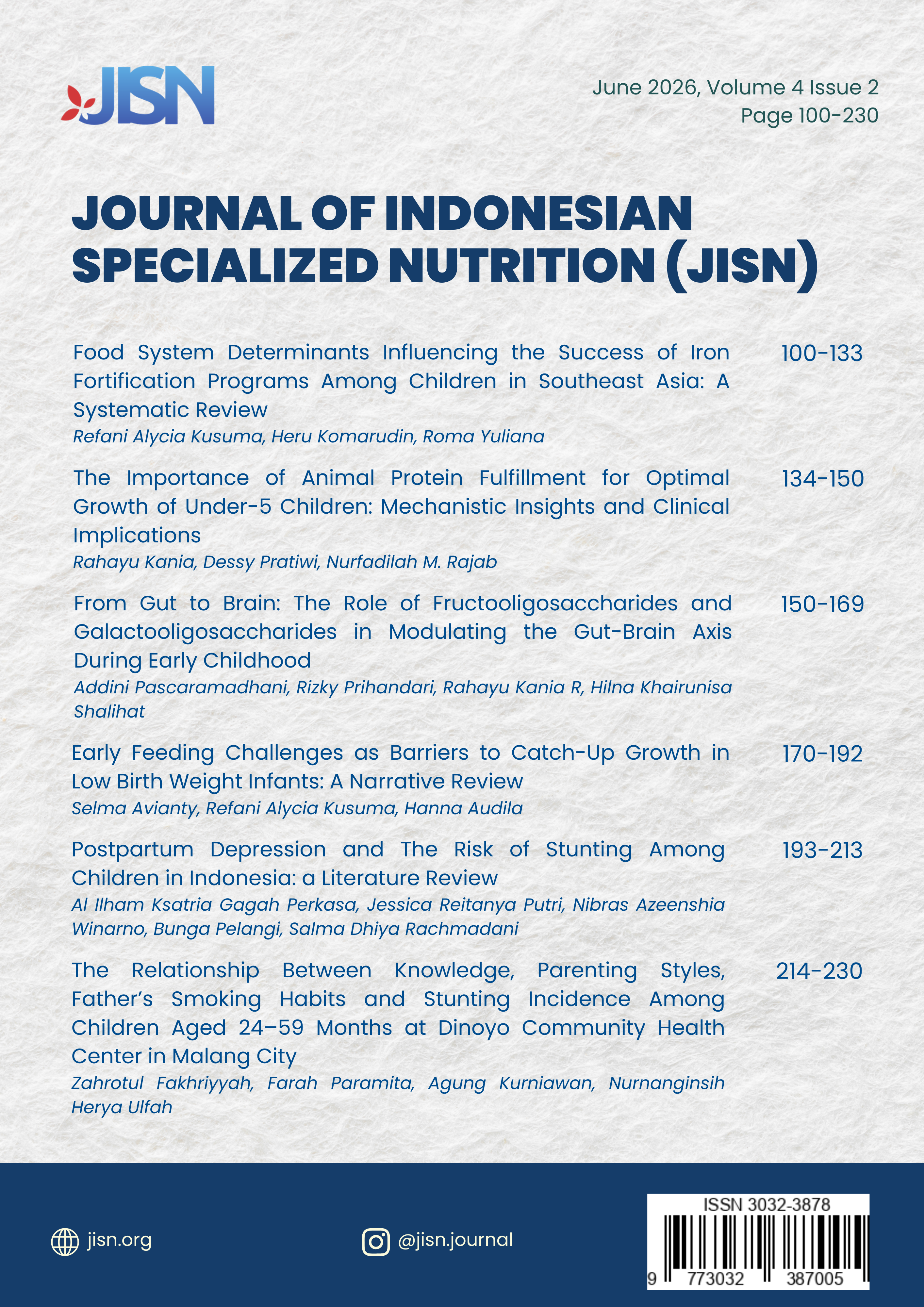
EARLY FEEDING CHALLENGES AS BARRIERS TO CATCH-UP GROWTH IN LOW BIRTH WEIGHT INFANTS: A NARRATIVE REVIEW
DOI:
https://doi.org/10.63953/jisn.v4i2.84Keywords:
Low birth weight, Catch-up growth, feeding difficulties, infant nutrition, growth falteringAbstract
Background: Low birth weight (LBW) infants are highly vulnerable to postnatal growth failure due to physiological immaturity, increased metabolic demands, and feeding-related complications. Early feeding challenges may interfere with adequate nutritional intake during a critical period of growth and development, thereby impairing catch-up growth. Objective: This narrative review aimed to synthesize current evidence regarding early feeding challenges as barriers to catch-up growth in LBW infants. Methods: A narrative literature search was conducted using PubMed, Scopus, ScienceDirect, and Google Scholar databases. Relevant articles published between 2016 and 2026 were reviewed, focusing on feeding difficulties, nutritional management, and growth outcomes in LBW infants. Results: Early feeding challenges in LBW infants include impaired suck–swallow coordination, feeding intolerance, delayed enteral feeding progression, breastfeeding difficulties, and inadequate post-discharge feeding support. These factors may contribute to insufficient energy and protein intake, impaired nutrient utilization, and persistent growth faltering. Inadequate catch-up growth is associated with adverse neurodevelopmental, immunological, and metabolic outcomes. Conclusion: Early feeding challenges are major barriers to optimal catch-up growth in LBW infants. Comprehensive nutritional and multidisciplinary interventions are essential to support balanced postnatal growth and improve long-term health outcomes.
References
Aga MA, Woldeamanuel BT. Nutritional and prenatal care factors associated with low birth weight among full-term infants in public hospitals of Addis Ababa, Ethiopia. BMJ Paediatr Open [Internet]. 2025;9(1):1–10. Available from: https://doi.org/10.1136/bmjpo-2025-003732
Okwaraji YB, Krasevec J, Bradley E, Conkle J, Stevens GA, Gatica-Domínguez G, et al. National, regional, and global estimates of low birthweight in 2020, with trends from 2000: a systematic analysis. Lancet [Internet]. 2024;403(10431):1071–80. Available from: https://doi.org/10.1016/S0140-6736(23)01198-4
World Health Organization (WHO), United National Children’s Funds (UNICEF). Global nutrition targers 2030 : Low birth weight brief. World Health Organization. Geneva; 2025.
World Health Organization (WHO), United National Children’s Funds (UNICEF). Country Consultation on Low Birthweight and Preterm Birth Estimates : Technical Notes. Geneva, Switzerland; 2023. 1–60 p.
Kassie GA, Gebrekidan AY, Adella GA, Woldegeorgis BZ, Haile KE, Workineh A, et al. Socioeconomic inequality and determinants of low birth weight in Kenya: a multilevel analysis using 2022 demographic and health survey. Ital J Pediatr [Internet]. 2025;51(1):1–10. Available from: https;//doi.org/10.1186/s13052-025-02074-9
Marsubrin PMT, Ibrahim NAA, Dilmy MAF, Ariani Y, Wiweko B, Irwinda R, et al. Determinants of prematurity in urban Indonesia: a meta-analysis. J Perinat Med [Internet]. 2024;52(3):270–82. Available from: https://doi.org/10.1515/jpm-2023-0151
Haksari EL, Irawan G, Lusyati SD, Wibowo T, Yunanto A, Rukmono P, et al. Neonatal mortality and survival of low-birth-weight infants at hospitals in indonesia, a multi center study. Sci Rep [Internet]. 2025;15(1):1–12. Available from: https://doi.org/10.1038/s41598-025-16401-x
Frontera W, Spicer CM, Applegate A. Low birth weight babies and disability [Internet]. Low Birth Weight Babies and Disability. Washington, DC: National Academies Press; 2024. 1–246 p. Available from: https://doi.org/10.17226/27375.
van Wyk L, Boers KE, van Wassenaer-Leemhuis AG, van der Post JAM, Bremer HA, Delemarre FMC, et al. Postnatal Catch-Up Growth After Suspected Fetal Growth Restriction at Term. Front Endocrinol (Lausanne) [Internet]. 2019;10(June):1–10. Available from: https://doi.org/10.3389/fendo.2019.00274
Martin A, Connelly A, Bland RM, Reilly JJ. Health impact of catch-up growth in low-birth weight infants: systematic review, evidence appraisal, and meta-analysis. Matern Child Nutr [Internet]. 2017;13(1):1–13. Available from: https://doi.org/10.1111/mcn.12297
Reva Audria Khairani, Tri Faranita, Yanti Harjono Hadiwiardjo, Fachri Razi Arslan. Effect of gestational age on growth of low birth weight infant: retrospective cohort study. Pediatr Sci J [Internet]. 2024;5(2):56–9. Available from: https://doi.org/10.51559/pedscij.v5i2.101
Lestari H, As’ad S, Yusuf I, Umboh A, Febriani ADB. Developmental performance in small for gestational age children with and without catch-up growth. Pediatr Indones [Internet]. 2015;55(4):199–202. Available from: https://doi.org/10.14238/pi55.4.2015.199-202
Chen CY, Lai MY, Lee CH, Chiang MC. Nutritional Management for Preterm Infants with Common Comorbidities: A Narrative Review. Nutrients [Internet]. 2025;17(12):1–20. Available from: https://doi.org/10.3390/nu17121959
Kamity R, Kapavarapu PK, Chandel A. Feeding problems and long-term outcomes in preterm infants—A systematic approach to evaluation and management. Children [Internet]. 2021;8(12):1–16. Available from: https://doi.org/10.3390/children8121158
Sawasawa C, Naidoo L, Hoosen SS. Feeding and swallowing difficulties in previously hospitalised premature infants in the neonatal intensive care unit: Perspectives from South African caregivers. South African J Commun Disord [Internet]. 2025;72(2):1–9. Available from: https://doi.org/10.4102/sajcd.v72i2.1119
Tang M, Wang Y, Yang F, Xiang Y, Wu J. Etiological Patterns of Protein-Energy Malnutrition in a Pediatric Clinic in China. Med Sci Monit [Internet]. 2025;31(e946284):1–7. Available from: https://doi.org/10.12659/MSM.946284
Rahayu A, Yulidasari F, Anggraini L, Rahman F, Laily N, Sari AR, et al. Energy and Protein Intake-Related Risks Affected the Occurrence of Stunting Among Young Children. Adv Heal Sci Res [Internet]. 2020;22(Ishr 2019):330–6. Available from: https://doi.org/10.2991/ahsr.k.200215.063
Ortigoza EB. Feeding intolerance. Early Hum Dev [Internet]. 2022;171(105601):1–17. Available from: https://doi.org/10.1016/j.earlhumdev.2022.105601
Zhao H, Guo C, Xie G, Tong Y, Wu Y. Feeding intolerance as an independent risk factor for extrauterine growth restriction and neurodevelopmental impairment in small  for  gestational  age preterm infants : a retrospective cohort study. Eur J Med Res [Internet]. 2026;31(589):1–12. Available from: https://doi.org/10.1186/s40001-026-04197-z
Zhao H, Qi H, Xu R, Xie G. Risk factors and clinical features of feeding intolerance in preterm infants and the effect of multimodal oral–sucking–oromotor training: a single-center retrospective analysis. J Matern Neonatal Med [Internet]. 2026;39(1):1–15. Available from: https://doi.org/10.1080/14767058.2026.2617714
Vesel L, Bellad RM, Manji K, Saidi F, Velasquez E, Sudfeld CR, et al. Feeding practices and growth patterns of moderately low birthweight infants in resource-limited settings: results from a multisite, longitudinal observational study. BMJ Open [Internet]. 2023;13(2):1–12. Available from: https://10.0.4.112/bmjopen-2022-067316
Amaniyo L, Dektar B, Nakibuuka V, Nankunda J, Opoka R, Kiguli S. Prevalence of sub-optimal feeding practices and associated factors in very low birth weight infants admitted to the special care unit, Kawempe Hospital in Uganda. Front Pediatr [Internet]. 2025;13(June):1–14. Available from: https://doi.org/10.3389/fped.2025.1558163
Mertens A, Benjamin-Chung J, Colford JM, Coyle J, van der Laan MJ, Hubbard AE, et al. Causes and consequences of child growth faltering in low-resource settings. Nature [Internet]. 2023;621(7979):568–76. Available from: https://doi.org/10.1038/s41586-023-06501-x
Alur P, Ramarao S. Transition phase of nutrition—optimizing nutrient administration. Front Pediatr [Internet]. 2025;13(September):1–6. Available from: https://doi.org/10.3389/fped.2025.1658550
Latif S, Khalid N. Challenges and management of nutrition in preterm infants with reference to developing countries. Nutr Health [Internet]. 2025;31(2):335–8. Available from: https://doi.org/10.1177/02601060251347036
Moret-Tatay A, Pérez-Bermejo M, Asins-Cubells A, Moret-Tatay C, Murillo-Llorente MT. A Systematic Review of Multifactorial Barriers Related to Breastfeeding. Healthc [Internet]. 2025;13(11):1–15. Available from: https://doi.org/10.3390/healthcare13111225
Jiang S, Sung J, Sawhney R, Cai J, Xu H, Ng SK, et al. The determinants of growth failure in children under five in 25 low and middle-income countries. J Glob Health [Internet]. 2023;13(04077):1–15. Available from: https://doi.org/10.7189/JOGH.13.04077
Kale PL, Fonseca SC. Intrauterine growth restriction, prematurity, and low birth weight: risk phenotypes of neonatal death, Rio de Janeiro State, Brazil. Cad Saude Publica [Internet]. 2023;39(6):1–13. Available from: https://doi.org/10.1590/0102-311XEN231022
Lin CY, Chang HY, Chang JH, Hsu CH, Jim WT, Peng CC, et al. The impact of small-for-gestational-age Status on the outcomes in very-Low-birth-weight (VLBW) premature infants: a prospective cohort study in Taiwan. Front Pediatr [Internet]. 2023;11(July):1–11. Available from: https://doi.org/10.3389/fped.2023.1209765
Zhu L, Yao D. Small for Gestational Age and Motor Development in Children: A Narrative Review of Risk Factors, Brain Mechanisms, and Early Interventions. Dev Neurosci [Internet]. 2025 Oct 27;1(1):1–15. Available from: https://doi.org/10.1159/000548975
Gupta P, Paul PG, Jain V. Catch-up growth in low birth weight infants. J Pediatr Endocrinol Diabetes [Internet]. 2025;5(2):73–81. Available from: https://doi.org/10.25259/jped_45_2024
Cooke R, Goulet O, Huysentruyt K, Joosten K, Khadilkar AV, Mao M, et al. Catch-Up Growth in Infants and Young Children With Faltering Growth: Expert Opinion to Guide General Clinicians. J Pediatr Gastroenterol Nutr [Internet]. 2023;77(1):7–15. Available from: https://doi.org/10.1097/MPG.0000000000003784
Stenson CL, Wood CL, Embleton ND. Catch-up growth and the developmental origins of health in preterm infants. Infant. 2016;12(3):82–6.
Christian P, Lee SE, Angel MD, Adair LS, Arifeen SE, Ashorn P, et al. Risk of childhood undernutrition related to small-for-gestational age and preterm birth in low- and middle-income countries. Int J Epidemiol [Internet]. 2013;42(5):1340–55. Available from: https://doi.org/10.1093/ije/dyt109
Nguyen PT, Nguyen PH, Tran LM, Khuong LQ, Van Nguyen S, Young MF, et al. Growth patterns of preterm and small for gestational age children during the first 10 years of life. Front Nutr [Internet]. 2024;11(February):1–12. Available from: https://doi.org/10.3389/fnut.2024.1348225
González-Fernández D, Cousens S, Rizvi A, Chauhadry I, Soofi SB, Bhutta ZA. Infections and nutrient deficiencies during infancy predict impaired growth at 5 years: Findings from the MAL-ED study in Pakistan. Front Nutr [Internet]. 2023;10(February):1–15. Available from: https://doi.org/10.3389/fnut.2023.1104654
Simone Thanh Nguyen, Marcelle Thrinh. The Role of Chronic Inflammation in Stunting-Associated Cognitive Impairment in Hanoi, Vietnam. Sci J Pediatr [Internet]. 2023;1(2):102–15. Available from: https://doi.org/10.59345/sjped.v1i2.68
Inadera H. Developmental origins of obesity and type 2 diabetes: Molecular aspects and role of chemicals. Environ Health Prev Med [Internet]. 2013;18(3):185–97. Available from: https://doi.org/10.1007/s12199-013-0328-8
Hoffman DJ, Powell TL, Barrett ES, Hardy DB. Developmental Origins of Metabolic Diseases. Physiol Rev [Internet]. 2021;101(3):739–95. Available from: https://doi.org/10.1152/physrev.00002.2020
Hartati KU, Margono M, Purborini N. Nutrition care in baby with low birth weight. Proceeding Int Conf Adv Nurs Care. 2025;2(1):1–4.
Manuaba IAWKD, Dharma BDI. Feeding Therapy in Preterm Infants. Surabaya Phys Med Rehabil J [Internet]. 2023;5(1):37–42. Available from: https://doi.org/10.20473/spmrj.v5i1.33905
Astuti DD, Rustina Y, Wanda D. Oral feeding skills in premature infants: A concept analysis. Belitung Nurs J [Internet]. 2022;8(4):280–6. Available from: https://doi.org/10.33546/bnj.2107
Nakubulwa C, Musiime V, Namiiro FB, Tumwine JK, Hongella C, Nyonyintono J, et al. Delayed initiation of enteral feeds is associated with postnatal growth failure among preterm infants managed at a rural hospital in Uganda. BMC Pediatr [Internet]. 2020;20(1):1–9. Available from: https://doi.org/10.1186/s12887-020-1986-5
Salasa AA, Travers CP. The practice of enteral nutrition. Clin Perinatol [Internet]. 2023;50(3):607–23. Available from: https://doi.org/10.1016/j.clp.2023.04.005.
Young L, Oddie S, McGuire W. Delayed introduction of progressive enteral feeds to prevent necrotising enterocolitis in very low birth weight infants. Cochrane Database Syst Rev [Internet]. 2022 Jan 20;2022(1):1–10. Available from: https://doi.org/10.1002/14651858.CD001970.pub6
Albraik RK, Shatla E, Abdulla YM, Ahmed EH. Neonatal Feeding Intolerance and Its Characteristics: A Descriptive Study. Cureus [Internet]. 2022;14(9):1–6. Available from: https://doi.org/10.7759/cureus.29291
Chen L, Shang Y, Tian X, Huang Y, Sun Y, Fu C, et al. The struggles of breastfeeding mothers of preterm infants: a qualitative study. BMC Pregnancy Childbirth [Internet]. 2025;25(472):1–13. Available from: htpps://doi.org/10.1186/s12884-025-07597-x
Wasir R, Rahma F, Apriningsih, Basrowi RW, Saputra H, Zaid M. Implementation of perinatal mental health policy in Indonesia: a systematic review. Gen Med / Obs Med. 2025;27(6):65–70.
Gianni ML, Bettinelli ME, Manfra P, Sorrentino G, Bezze E, Plevani L, et al. Breastfeeding difficulties and risk for early breastfeeding cessation. Nutrients [Internet]. 2019;11(10):1–10. Available from: https://doi.org/10.3390/nu11102266
Sithamparapillai K, Samaranayake D, Wickramasinghe VP. Timing and pattern of growth faltering in children up-to 18 months of age and the associated feeding practices in an urban setting of Sri Lanka. BMC Pediatr [Internet]. 2022;22(1):1–10. Available from: https://doi.org/10.1186/s12887-022-03265-7
Yanti ES, Yunus EM. Low Birth Weight and Inappropriate Feeding Variation Caused Nutritional Disorders Based on the Composite Index of Anthropometric Failure (Ciaf). Media Gizi Indones [Internet]. 2024;19(3):311–21. Available from: https://doi.org/10.20473/mgi.v19i3.311-321
Killion KE, Corcoran A, Romo-Palafox MJ, Harris JL, Kagan I, Gilbert L, et al. Responsive Feeding Practices to Promote Healthy Diets: A Mixed Method Study among Low-Income Caregivers with Toddlers. Nutrients [Internet]. 2024;16(6):1–19. Available from: https://doi.org/10.3390/nu16060863
Sharn AR, Oliveros E, Lai S, Sanchez CP, Villa-Real Guno MJ, Rojas Montenegro C. Multi-faceted nutritional interventions are imperative to reduction of stunting among children in low- and middle-income countries. Front Nutr [Internet]. 2025;12(September):1–11. Available from: https://doi.org/10.3389/fnut.2025.1479850
Wahyuni FC, Karomah U, Basrowi RW, Sitorus NL, Lestari LA. The Relationship between Nutrition Literacy and Nutrition Knowledge with the Incidence of Stunting: A Scoping Review. Amerta Nutr [Internet]. 2023;7(3SP):71–85. Available from: https://doi.org/10.20473/amnt.v7i3SP.2023.71-85
Hariati S, Erfina, Lusmilasari L. Related factors of postnatal growth failure upon hospital discharge among low-birth-weight infants in Eastern Indonesia. Pediomaternal Nurs J [Internet]. 2026;12(1):17–24. Available from: https://doi.org/10.20473/pmnj.v12i1.74789
Raturi S, Daniel LM, Shi L, Rajadurai VS, Agarwal PK. Nutritional intake and growth velocity in preterm extremely low-birthweight infants in Asia: Are we doing enough? J Pediatr Child Heal [Internet]. 2017;53(1):1199–1207. Available from: https://doi.org/10.1111/jpc.13630
Muelbert M, Harding JE, Bloomfield FH. Nutritional policies for late preterm and early term infants – can we do better? Semin Fetal Neonatal Med [Internet]. 2019;24(1):43–7. Available from: https://doi.org/10.1016/j.siny.2018.10.005
Abbas A. Feeding of low birth weight (LBW) and very low birth weight (VLBW) Infants. Fetal, Neonatal Dev Med [Internet]. 2017;1(1):1–2. Available from: https://doi.org/10.15761/fndm.1000102
World Health Organization. Guidelines on optimal feeding of low birth-weight infants in low-and middle-income countries. Geneva: WHO. Geneva, Switzerland: WHO; 2011. 16–45 p.
Escobedo-Monge MF, Parodi-Román J, Escobedo-Monge MA, Marugán-Miguelsanz JM. The Biological Value of Proteins for Pediatric Growth and Development: A Narrative Review. Nutrients [Internet]. 2025;17(13):1–23. Available from: https://doi.org/10.3390/nu17132221
Hay WW. Amino acids and protein for preterm infants: How much and for what? Semin Fetal Neonatal Med [Internet]. 2025;30(2):101633. Available from: https://doi.org/10.1016/j.siny.2025.101633
Uberos-Fernández J, Ruiz-López A, Carrasco-Solis M, Fernandez-Marín E, Garcia-Cuesta A, Campos-Martínez A. Extrauterine growth restriction and low energy intake during the early neonatal period of very low birth weight infants are associated with decreased lung function in childhood. Br J Nutr [Internet]. 2023;130(12):2095–103. Available from: https://doi.org/10.1017/S0007114523001332
Brinkis R, Albertsson-Wikland K, Tamelienė R, Vinskaitė A, Šmigelskas K, Verkauskienė R. Nutrient Intake with Early Progressive Enteral Feeding and Growth of Very Low-Birth-Weight Newborns. Nutrients [Internet]. 2022;14(6):1–15. Available from: https://doi.org/10.3390/nu14061181
Vitale G, Pellegrino G, Vollery M, Hofland LJ. Role of IGF-1 system in the modulation of longevity: Controversies and new insights from a centenarians’ perspective. Front Endocrinol (Lausanne) [Internet]. 2019;10(FEB):1–11. Available from: https://doi.org/10.3389/fendo.2019.00027
Hawkes CP, Grimberg A, Health C. Insulin-Like Growth Factor-I is a Marker for the Nutritional State. Pediatr Endocrinol Rev. 2015;13(2):499–511.
Indrio F, Neu J, Pettoello-Mantovani M, Marchese F, Martini S, Salatto A, et al. Development of the Gastrointestinal Tract in Newborns as a Challenge for an Appropriate Nutrition: A Narrative Review. Nutrients [Internet]. 2022;14(7):1–15. Available from: https://doi.org/10.3390/nu14071405
Marsubrin PMT, Firmansyah A, Rohsiswatmo R, Munasir Z, Bardosono S, Malik SG, et al. Association between feeding intolerance and intestinal dysbiosis in very premature infants. Clin Exp Pediatr [Internet]. 2023;66(11):501–3. Available from: https://doi.org/10.3345/cep.2023.00829
DeBoer MD, Scharf RJ, Leite AM, Férrer A, Havt A, Pinkerton R, et al. Systemic inflammation, growth factors, and linear growth in the setting of infection and malnutrition. Nutrition [Internet]. 2017;33:248–53. Available from: https://doi.org/10.1016/j.nut.2016.06.013
Dargenio VN, Sgarro N, Grasta G La, Begucci M, Castellaneta SP, Dargenio C, et al. Hidden Hunger in Pediatric Obesity: Redefining Malnutrition Through Macronutrient Quality and Micronutrient Deficiency. Nutrients. 2025;17(22):1–37.
Cammisa I, Rigante D, Cipolla C. A Theoretical Link Between the GH/IGF-1 Axis and Cytokine Family in Children: Current Knowledge and Future Perspectives. Children [Internet]. 2025;12(4):1–20. Available from: https://doi.org/10.3390/children12040495
Möllers LS, Yousuf EI, Hamatschek C, Morrison KM, Hermanussen M, Fusch C, et al. Metabolic-endocrine disruption due to preterm birth impacts growth, body composition, and neonatal outcome. Pediatr Res [Internet]. 2022;91:1350–60. Available from: https://doi.org/10.1038/s41390-021-01566-8
Tan JBC, Boskovic DS, Angeles DM. The Energy Costs of Prematurity and the Neonatal Intensive Care Unit (NICU) Experience. Antioxidants [Internet]. 2018;7(3):1–13. Available from: https://doi.org/10.3390/antiox7030037
Farajdokht F, Sadigh-Eteghad S, Dehghani R, Mohaddes G, Abedi L, Bughchechi R, et al. Very low birth weight is associated with brain structure abnormalities and cognitive function impairments: A systematic review. Brain Cogn [Internet]. 2017;118:80–9. Available from: https://doi.org/10.1016/j.bandc.2017.07.006
Soliman A, De Sanctis V, Alaaraj N, Ahmed S, Alyafei F, Hamed N, et al. Early and long-term consequences of nutritional stunting: From childhood to adulthood. Acta Biomed [Internet]. 2021;92(1):1–12. Available from: https://doi.org/10.23750/abm.v92i1.11346
Medise BE. Growth and development in preterm infants: what is the long-term risk? Amerta Nutr [Internet]. 2021;5(Supl.27033):27–33. Available from: https://doi.org/10.20473/amnt.V5i1SP.2021.27-33
Walsh V, Brown JVE, Copperthwaite BR, Oddie SJ, McGuire W. Early full enteral feeding for preterm or low birth weight infants. Cochranr Database Systeatic Rev [Internet]. 2020;12:1–10. Available from: https://doi.org/10.1002/14651858.CD013542.pub2
Yang J, Tang Q, Zhou P. Narrative review of methodological advances in human milk fortification: for better preterm infant growth. Front Pediatr [Internet]. 2024;12:1–7. Available from: https://doi.org/10.3389/fped.2024.1466528
Rinawati R. Nutritional Management and Recommendation for Preterm Infants : A Narrative Review. Amerta Nutr [Internet]. 2021;5(Supp1-13):1–13. Available from: https://doi.org/10.20473/amnt. V5i1SP.2021.1-13
Mekonnen AG, Yehualashet SS, Bayleyegn AD. The effects of kangaroo mother care on the time to breastfeeding initiation among preterm and LBW infants: a meta-analysis of published studies. Int Breastfeed J [Internet]. 2019;14(12):1–6. Available from: https://doi.org/10.1186/s13006-019-0206-0
K SM, H CE, J SM, M SJ, Ping WY, E BNS, et al. Caregiver feeding practices and child weight outcomes: a systematic review. Am J Clin Nutr [Internet]. 2019;109(1):990S-1002S. Available from: https://doi.org/10.1093/ajcn/nqy276
Hastuti D, Anggorowati, Zubaidah Z. Developmental care for preterm infants: a scoping review of interventions, outcomes, and implementation contexts. Front Pediatr [Internet]. 2026;14:1–13. Available from: https://doi.org/10.3389/fped.2026.1730571
Dagla M, Mrvoljak-Theodoropoulou I, Vogiatzoglou M, Giamalidou A, Tsolaridou E, Mavrou M, et al. Association between Breastfeeding Duration and Long-Term Midwifery-Led Support and Psychosocial Support: Outcomes from a Greek Non-Randomized Controlled Perinatal Health Intervention. Int J Environ Res Public Health [Internet]. 2021;18(4):1–17. Available from: https://doi.org/10.3390/ijerph18041988
Sentika R, Setiawan T, Kusnadi, Rattu DJ, Yunita I, Masita BM, et al. The Importance of Interprofessional Collaboration (IPC) Guidelines in Stunting Management in Indonesia: A Systematic Review. Healthc [Internet]. 2024;12(22):1–16. Available from: https://doi.org/10.3390/healthcare12222226
Sentika R, Setiawan T, Kusnadi, Rattu DJ, Yunita I, Basrowi RW, et al. Expert Consensus on Interprofessional Collaboration (IPC) Guidelines on Stunting Management in Indonesian Primary Healthcare (Puskesmas). Open Public Health J [Internet]. 2024;17(1):1–12. Available from: https://doi.org/10.2174/0118749445352608241119164446
Ja´nczewska I, Wierzba J, Ja´nczewska A, Szczurek-Gierczak M, Domzalska-Popadiuk I. Prematurity and Low Birth Weight and Their Impact on Childhood Growth Patterns and the Risk of Long-Term Cardiovascular Sequelae. Children [Internet]. 2013;10(10):1–15. Available from: https://doi.org/10.3390/children10101599
Downloads
Published
Issue
Section
License
Copyright (c) 2026 Selma Avianty, Refani Alycia Kusuma, Hanna Audila

This work is licensed under a Creative Commons Attribution-ShareAlike 4.0 International License.
Authors retain copyright and grant the journal the right of first publication with the work simultaneously licensed under a Creative Commons Attribution-ShareAlike 4.0 International (CC-BY-SA) that allows others to share the work with an acknowledgment of the work's authorship and initial publication in this journal.
Authors are able to enter into separate, additional contractual arrangements for the non-exclusive distribution of the journal's published version of the work (e.g., post it to an institutional repository or publish it in a book), with an acknowledgment of its initial publication in this journal.
Authors are permitted and encouraged to post their work online (e.g., in institutional repositories or on their website) prior to and during the submission process, as it can lead to productive exchanges, as well as earlier and greater citation of published work.
LICENSE TO PUBLISH
- All material published by the Journal of Indonesian Specialized Nutrition is protected under International copyright and intellectual property laws. Journal of Indonesian Specialized Nutrition is licensed under a Creative Commons Attribution-ShareAlike 4.0 International (CC-BY-SA) or an equivalent license as the optimal license for the publication, distribution, use, and reuse of scholarly works.
- This license permits anyone to compose, repair, and make derivative creations even for commercial purposes, as long as appropriate credit and proper acknowledgment of the original publication from a journal are made to allow users to trace back to the original manuscript and author.
- You must give appropriate credit, provide a link to the license, and indicate if changes were made. You may do so in any reasonable manner, but not in any way that suggests the licensor endorses you or your use. If you remix, transform or build upon the material, you must distribute your contributions under the same license as the original.