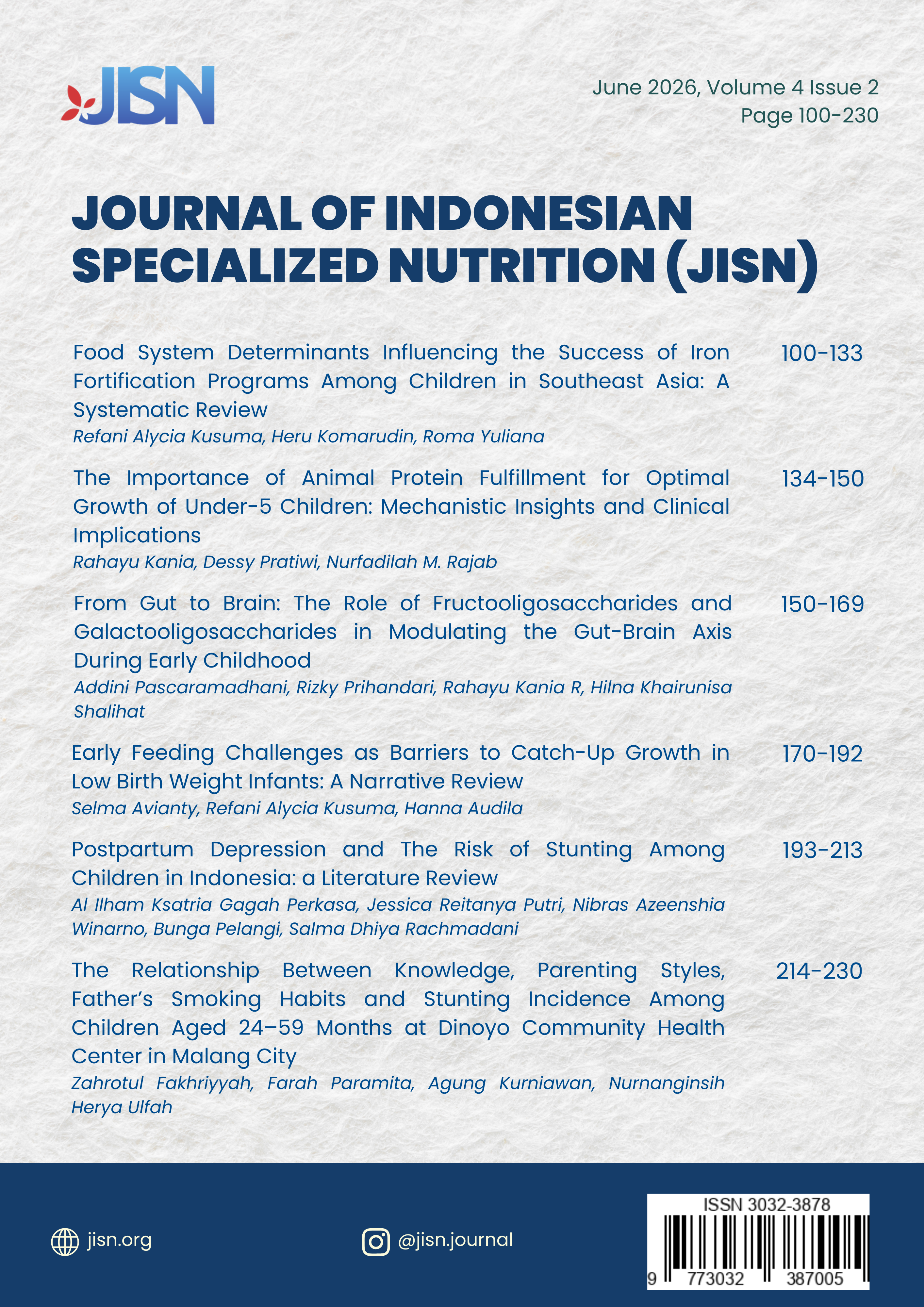
FOOD SYSTEM DETERMINANTS INFLUENCING THE SUCCESS OF IRON FORTIFICATION PROGRAMS AMONG CHILDREN IN SOUTHEAST ASIA: A SYSTEMATIC REVIEW
DOI:
https://doi.org/10.63953/jisn.v4i2.85Keywords:
Iron fortification, Food Systems, Anemia, Children, Southeast AsiaAbstract
Background: Iron deficiency and anemia remain major public health challenges among children in Southeast Asia, contributing to impaired growth, cognitive development, and long-term health outcomes. Although iron fortification has been widely implemented, program effectiveness has remained inconsistent across the region. This systematic review aimed to examine food system determinants influencing the success of iron fortification programs among children in Southeast Asia and their implications for Indonesia. Methods: A systematic review was conducted following the PRISMA 2020 guidelines. Literature searches were performed using PubMed/MEDLINE and Scopus. Studies published between 2015 and 2026 were screened for eligibility. Quantitative, qualitative, mixed-methods, and implementation studies evaluating iron fortification interventions among children in Southeast Asia were included. Data were synthesized narratively using a food systems perspective. Results: Nine studies were included, primarily randomized controlled trials and community-based interventions conducted in Cambodia and Indonesia. Iron fortification interventions, particularly fortified rice delivered through school feeding programs, generally improved hemoglobin levels, micronutrient status, and cognitive outcomes. However, intervention effectiveness was influenced by adherence, cultural acceptability, caregiver practices, inflammation, gut health, and implementation sustainability. Conclusions: The success of iron fortification programs was influenced not only by nutrient delivery but also by broader food system determinants. Integrated food systems approaches were considered essential to improve child nutrition outcomes in Southeast Asia, particularly in Indonesia.
References
Habib MJ, Sakib MS, Baten A, Tareq M. Consumption of iron rich foods and its associated factors among South Asian children aged 6–23 months using multilevel analysis. Sci Rep [Internet]. 2025;15(1):1–11. Available from: https://doi.org/10.1038/s41598-025-26932-y
Martinez-Torres V, Torres N, Davis JA, Corrales-Medina FF. Anemia and Associated Risk Factors in Pediatric Patients. Pediatr Heal Med Ther. 2023;Volume 14(August):267–80.
Charles C V, Summerlee AJ, Dewey CE. Anemia in Cambodia: prevalence, etiology and research needs. Asia Pac J Clin Nutr. 2012;21(2):171–81.
United National Children’s Funds (UNICEF). Regional Operational Guidance on Children Aged 6-59 Months Anemia [Internet]. UNICEF; 2025. 1–36 p. Available from: https://www.unicef.org/wca/reports/regional-operational-guidance-children-aged-6-59-months-anemia
Sunuwar D, Singh D, Man P, Pradhan S, Shrestha V, Rai P. Factors associated with anemia among children in South and Southeast Asia : a multilevel analysis. BMC Public Health [Internet]. 2023;23(343):1–17. Available from: https://doi.org/10.1186/s12889-023-15265-y
Rahma N, Kalsum U, Halim R. Factors Related to Anaemia in Toddlers Aged 6 - 59 Months in Indonesia (Riskesdas Data Analysis 2018). J iKes [Internet]. 2026;5(X):12–24. Available from: https://doi.org/10.52225/JurnalIKES.v51[X[.[X]
Kementerian Kesehatan Republik Indonesia. Riset Kesehatan Dasar 2018. https://repository.kemkes.go.id/book/1323. 2018.
L AP, Uma A. Anemia In Children: A Persistent Global Challenge. Vol. 14, Challenge. Journal of Neonatal Surgery. 2025.
Oktarina C, Dilantika C, Sitorus NL, Basrowi RW. Relationship Between Iron Deficiency Anemia and Stunting in Pediatric Populations in Developing Countries: A Systematic Review and Meta-Analysis. Children [Internet]. 2024;11(10):1–14. Available from: https://doi.org/10.3390/children11101268
Obeagu EI. Iron homeostasis and health: understanding its role beyond blood health – a narrative review. Ann Med Surg [Internet]. 2025;87(6):3362–71. Available from: https://doi.org/10.1097/ms9.0000000000003100
Basrowi RW, Zulfiqqar A, Sitorus NL. Anemia in Breastfeeding Women and Its Impact on Offspring’s Health in Indonesia: A Narrative Review. Nutrients. 2024;16(9):1–11.
Donker AE, van der Staaij H, Swinkels DW. The critical roles of iron during the journey from fetus to adolescent: Developmental aspects of iron homeostasis. Blood Rev. 2021;50(July):100866.
Georgieff MK. Long-term Brain and Behavioral Consequences of Early Iron Deficiency. Nutr Rev [Internet]. 2011;69(Suppl 1):S43–8. Available from: https://doi.org/10.1111/j.1753-4887.2011.00432.x.
Latifah S, Septiani S, Kusuma RA, Pratiwi D, Bergizi I, Revolusi P, et al. Iron Deficiency in Early Life And Later Behavioral Outcomes : A Systematic Review. J Indones Spec Nutr [Internet]. 2025;03(04):287–316. Available from: https://doi.org/10.63953/jisn.v3i4.67
East P, Doom JR, Blanco E, Burrows R, Lozoff B, Gahagan S. Iron Deficiency in Infancy and Neurocognitive and Educational Outcomes in Young Adulthood. Dev Psychol [Internet]. 2021;57(6):962–75. Available from: https://doi.org/10.1037/dev0001030
Gao Q, Zhou Y, Chen Y, Hu W, Jin W, Zhou C, et al. Role of iron in brain development, aging, and neurodegenerative diseases. Ann Med. 2025;57(1):1–20.
United National Children’s Funds (UNICEF). Southeast Asia Regional Report on Maternal Nutrition and Complementary Feeding Southeast Asia Regional Report on Maternal Nutrition and Complementary Feeding UNICEF East Asia and Pacific Region. Thailand: Nutrition Section at UNICEF EAPRO; 2021. 1–83 p.
Sukwuttichai P, Tidwong N, Chaipichit N, Dhippayom T, Dilokthornsakul W, Dilokthornsakul P. Global prevalence of iron deficiency anaemia among children aged 5-12 years: a systematic review and meta-analysis. J Glob Health [Internet]. 2026;16(04027):1–15. Available from: https://doi.org/10.7189/jogh.16.04027
Soni R, Verma D, Chopra R, Singh V, Goswami D. Demystifying intricate factors of nutritional anemia beyond iron deficiency–A narrative review. Clin Nutr ESPEN [Internet]. 2025;69:745–64. Available from: https://doi.org/10.1016/j.clnesp.2025.08.034
López-Moreno M, Castillo-García A, Roldán-Ruiz A, Viña I, Bertotti G. Plant-Based Diet and Risk of Iron-deficiency Anemia. A Review of the Current Evidence and Implications for Preventive Strategies. Curr Nutr Rep [Internet]. 2025;14(81):1–8. Available from: https://doi.org/10.1007/s13668-025-00671-y
Omokpariola DO, Agbanu-kumordzi C, Omoefe G, Idris T, Samuel T, Andikan VD. Malnutrition and double burden of disease : the African dilemma of non-communicable disease. Front Sustain Food Syst [Internet]. 2026;10(1800043):1–14. Available from: https://doi.org/10.3389/fsufs.2026.1800043
Elegbeleye JA, Fayemi OE, Agbemavor WSK, Krishnamoorthy S, Adebowale OJ, Adeyanju AA, et al. Beyond Calories: Addressing Micronutrient Deficiencies in the World’s Most Vulnerable Communities—A Review. Nutrients [Internet]. 2025;17(24):1–25. Available from: https://doi.org/10.3390/nu17243960
Sunardi D, Bardosono S, Basrowi RW, Wasito E, Vandenplas Y. Dietary Determinants of Anemia in Children Aged 6–36 Months: A Cross-Sectional Study in Indonesia. Nutr 2021, Vol 13, Page 2397. 2021 Jul;13(7):2397.
Tareke AA, Temam AJ, Alem A, Geto Z, Assefa EM, Bihonegn MD, et al. The link between child dietary diversity and child anemia: The power of colorful plates. PLOS Glob Public Heal [Internet]. 2025;5(7):1–12. Available from: https://doi.org/10.1371/journal.pgph.0005001
Moosavian SP, Ghodsi M, Farzanehnejad P, Ghanbari N, Mirlohi SH, Moradi S. Association of food insecurity with anemia in children and adolescents: a systematic review and meta-analysis of observational studies. J Heal Popul Nutr. 2025;44(1):1–17.
Kaur N, Agarwal A, Sabharwal M. Food fortification strategies to deliver nutrients for the management of iron deficiency anaemia. Curr Res Food Sci [Internet]. 2022;5(October):2094–107. Available from: https://doi.org/10.1016/j.crfs.2022.10.020
Waller AW, Andrade JE, Mejia LA. Performance factors influencing efficacy and effectiveness of iron fortification programs of condiments for improving anemia prevalence and iron status in populations: A systematic review. Nutrients [Internet]. 2020;12(2):1–25. Available from: https://doi.org/10.3390/nu12020275
Keats EC, Neufeld LM, Garrett GS, Mbuya MNN, Bhutta ZA. Improved micronutrient status and health outcomes in low-and middle-income countries following large-scale fortification: Evidence from a systematic review and meta-Analysis. Am J Clin Nutr [Internet]. 2019;109(6):1696–708. Available from: http://dx.doi.org/10.1093/ajcn/nqz023
Gayer J, Smith G. Micronutrient fortification of food in southeast Asia: Recommendations from an expert workshop. Nutrients [Internet]. 2015;7(1):646–58. Available from: https://doi.org/10.3390/nu7010646
Helmyati S, Lusmilasari L, Sandhi A, Hardiyanti M, Rosilia G, Rachmawati YN, et al. Systematic review on supplementation, fortification, and food-based interventions for preventing iron deficiency anemia in low- and middle-income countries. Asia Pac J Clin Nutr [Internet]. 2025;34(1):10–35. Available from: https://doi.org/10.6133/apjcn.202502_34(1).0002
Freeman S, Clarke E. Investigation of Sustainability Challenges Faced by Food Fortification Programs Targeting Pregnant Women and Children in Developing Countries. J Food Sci Hum Nutr [Internet]. 2023;2(1):10–8. Available from: https://doi.org/10.58425/jfshn.v2i1.152
Zulfikar RRO, Mariani E, Gunawan C, Sitorus NL, Dilantika C, Sundjaya T, et al. Improving Iron Deficiency Anemia (IDA) Prevention and Management Strategies in Indonesia: An Expert Opinion. Open Public Health J [Internet]. 2025;18(1):1–11. Available from: https://doi.org/10.2174/0118749445361508250602094137
Luthringer CL, Rowe LA, Vossenaar M, Garrett GS. Regulatory monitoring of fortified foods: Identifying barriers and good practices. Glob Heal Sci Pract [Internet]. 2015;3(3):446–61. Available from: https;//doi.org/10.9745/GHSP-D-15-00171
Chan MJ, Tay GWN, Kembhavi G, Lim J, Rebello SA, Ng H, et al. Understanding children’s perspectives of the influences on their dietary behaviours. Public Health Nutr [Internet]. 2022;25(8):2156–66. Available from: https://doi.org/10.1017/S1368980022000404
Timpanaro G, Bellia C, Foti VT, Scuderi A. Consumer behaviour of purchasing biofortified food products. Sustain [Internet]. 2020;12(16):1–14. Available from: https://doi.org/10.3390/SU12166297
Brouwer ID, McDermott J, Ruben R. Food systems everywhere: Improving relevance in practice. Glob Food Sec [Internet]. 2020;26(100398):1–10. Available from: https://doi.org/10.1016/j.gfs.2020.100398
Karki R, Ojha P, Dongol DMS, Maharjan S, Manandhar U, Maharjan S. Food Fortification: Global Experience, Importance, Challenges and Potential in Nepal. J Food Sci Technol Nepal. 2024;14:69–88.
Agustina M. Critical Review of Food Fortification Policies in Developing Countries. Nutracendikia J [Internet]. 2025;1(1):1–8. Available from: https://doi.org/10.56861/nutracendikia.vlil
Fiorentino M, Perignon M, Kuong K, Burja K, Kong K, Parker M, et al. Rice Fortified with Iron in School Meals Improves Cognitive Performance in Cambodian School Children. Eur J Nutr Food Saf [Internet]. 2015;5(5):769–70. Available from: https://doi.org/10.9734/ejnfs/2015/21082
Perignon M, Fiorentino M, Kuong K, Dijkhuizen MA, Burja K, Parker M, et al. Impact of multi-micronutrient fortified rice on hemoglobin, iron and vitamin a status of cambodian schoolchildren: A double-blind cluster-randomized controlled trial. Nutrients [Internet]. 2016;8(1). Available from: https://doi.org/10.3390/nu8010029
Fiorentino M, Perignon M, Kuong K, De Groot R, Parker M, Burja K, et al. Effect of multi-micronutrient-fortified rice on cognitive performance depends on premix composition and cognitive function tested: Results of an effectiveness study in Cambodian schoolchildren. Public Health Nutr [Internet]. 2017;21(4):816–27. Available from: https://doi.org/10.1017/S1368980017002774
Akbar Toruntju S, Syam A, Palutturi S, Arif M, Hadju V, Razak Thaha A. Study of Hemoglobin and Ferritin Profile as Indicators in Children Hematology of 12-15 Years Provided Local Rice Fortification. Int J Sci Basic Appl Res Int J Sci Basic Appl Res. 2017;32(1):352–64.
Helmyati S, Shanti KM, Sari FT, Sari MP, Atmaka DR, Pratama RA, et al. Synbiotic fermented milk with double fortification (Fe-zn) as a strategy to address stunting: A randomized controlled trial among children under five in yogyakarta, indonesia. Processes [Internet]. 2021;9(3):1–11. Available from: https://doi.org/10.3390/pr9030543
Gasong LS, Damayanthi E, Marliyati SA, Martianto D. Formulation and Effect of Iron Fortified Instant Bose Corn on Addressing Anemia among Adolescent Girls in Kupang, Indonesia. Prev Nutr Food Sci. 2022;27(3):276–81.
Megawati M, Sudargo T, Susetyowati A. The Effect of Jelly Candy Snake Fruit and Banana With Ferrous Fumarat Fortified using Nano Technology in Adolescent Female at Junior High School. Pharmacogn J [Internet]. 2023;15(6):1150–5. Available from: https://doi.org/10.5530/pj.2023.15.209
Seyoum Y, Greffeuille V, Kouadio DKD, Kuong K, Turpin W, M’Rabt R, et al. Faecal microbiota of schoolchildren is associated with nutritional status and markers of inflammation: a double-blinded cluster-randomized controlled trial using multi-micronutrient fortified rice. Nat Commun [Internet]. 2024;15(1):1–12. Available from: https://doi.org/10.1038/s41467-024-49093-4
Helmyati S, Lestari LA, Aryanti L, Dwiutami H, Karomah U, Josef HK, et al. The Efficacy of Fortified Rice Consumption on Nutritional Status of Stunted Children Less Than Five Years Old in Yogyakarta, Indonesia. Int J Nutr Sci [Internet]. 2026;11(1):95–107. Available from: https://doi.org/10.30476/ijns.2026.106671.1458
Beerman KA, Massey L, McGeehan S, Ratts M, Mitchell T, Cotten C, et al. Can providing daily iron-fortified lunches to school-going children living in an impoverished Guatemalan community improve iron status? J Glob Heal Reports. 2023;7:1–8.
Hurrell RF. Ensuring the Efficacious Iron Fortification of Foods: A Tale of Two Barriers. Nutrients [Internet]. 2022;14(8):1–19. Available from: https;//doi.org/10.3390/nu14081609
Junaid-ur-Rahman S, Chughtai MFJ, Khaliq A, Liaqat A, Pasha I, Ahsan S, et al. Rice: a potential vehicle for micronutrient fortification. Clin Phytoscience [Internet]. 2022;8(1):1–14. Available from: https://doi.org/10.1186/s40816-022-00342-3
Karomah U, Dewi NMPK, Putri LP. Effectiveness of Food Fortification to Anemia in Adolescents: A Systematic Review and Meta-Analysis. Amerta Nutr [Internet]. 2024;8(3SP):466–77. Available from: https;//doi.org/10.20473/amnt.v8i3SP.2024.466-477
Drake L, Fernandes M, Aurino E. School Feeding Programs in Middle Childhood and Adolescence. In: Bundy D, Silva N, Horton S, Jamison DT, Patton GC, editors. Disease Control Priorities : Child and Adolescent Health and Development. 3th ed. Washington, DC: World Bank Group; 2017. p. 147–65.
Mildon A, Lopez de Romaña D, Jefferds MED, Rogers LM, Golan JM, Arabi M. Integrating and coordinating programs for the management of anemia across the life course. Ann N Y Acad Sci [Internet]. 2023;1525(1):160–72. Available from: https://doi.org/10.1111/nyas.15002
Osterholm EA, Georgieff MK. Chronic Inflammation and Iron Metabolism. J Pediatr [Internet]. 2017;166(6):1351–7. Available from: https;//doi.org/10.1016/j.jpeds.2015.01.017.Chronic
Kolarš B, Mijatovi V. Iron Deficiency and Iron Deficiency Anemia : A Comprehensive Overview of Established and Emerging Concepts. Pharmaceuticals [Internet]. 2025;18(1104):1–47. Available from: https://doi.org/10.3390/ph18081104
Hlaing LM, Htet MK, Gibson R, Utomo B, Firmansyah A, Fahmida U. Is iron supplementation likely to impair linear growth and gut microbiota composition of Myanmar young children when complementary feeding is not optimized ? A randomized controlled trial. Philos Trans B [Internet]. 2026;381(20250042):1–14. Available from: https://doi.org/10.1098/rstb.2025.0042/6137117/rstb.2025.0042.pdf
Baldi A, Braat S, Hasan MI, Bennett C, Barrios M, Jones N, et al. Effects of iron supplements and iron-containing micronutrient powders on the gut microbiome in Bangladeshi infants: a randomized controlled trial. Nat Commun [Internet]. 2024;15(1):1–12. Available from: http://dx.doi.org/10.1038/s41467-024-53013-x
Malesza IJ, Bartkowiak-Wieczorek J, Winkler-Galicki J, Nowicka A, Dzięciołowska D, Błaszczyk M, et al. The Dark Side of Iron: The Relationship between Iron, Inflammation and Gut Microbiota in Selected Diseases Associated with Iron Deficiency Anaemia—A Narrative Review. Nutrients. 2022;14(17):1–23.
Rusu IG, Suharoschi R, Vodnar DC, Pop CR, Socaci SA, Vulturar R, et al. Iron supplementation influence on the gut microbiota and probiotic intake effect in iron deficiency—A literature-based review. Nutrients [Internet]. 2020;12(7):1–17. Available from: https://doi.org/10.3390/nu12071993
Paganini D, Zimmermann MB. The effects of iron fortification and supplementation on the gut microbiome and diarrhea in infants and children: A review. Am J Clin Nutr. 2017;106(Suppl):1688S-1693S.
Zimmermann MB, Chassard C, Rohner F, N’Goran EK, Nindjin C, Dostal A, et al. The effects of iron fortification on the gut microbiota in African children: A randomized controlled trial in Côte d’Ivoire. Am J Clin Nutr [Internet]. 2010;92(6):1406–15. Available from: https://doi.org/10.3945/ajcn.110.004564
Silitonga HTH, Salim LA, Nurmala I, Wartiningsih M. Compliance of Iron Supplementation and Determinants among Adolescent Girls: A Systematic Review. Iran J Public Health [Internet]. 2023;52(1):37–48. Available from: https://doi.org/10.18502/ijph.v52i1.11664
Bloor SR, Schutte R, Hobson AR. Oral iron supplementation—gastrointestinal side effects and the impact on the gut microbiota. Microbiol Res (Pavia) [Internet]. 2021;12(2):491–502. Available from: https://doi.org/10.3390/microbiolres12020033
Finlayson-Trick ECL, Fischer JAJ, Goldfarb DM, Karakochuk CD. The Effects of Iron Supplementation and Fortification on the Gut Microbiota: A Review. Gastrointest Disord [Internet]. 2020;2(4):327–40. Available from: https://doi.org/10.3390/gidisord2040030
Le HT, Brouwer ID, Burema J, Nguyen KC, Kok FJ. Efficacy of iron fortification compared to iron supplementation among Vietnamese schoolchildren. Nutr J [Internet]. 2006;5(1):1–8. Available from: https://doi.org/10.1186/1475-2891-5-32
Ashraf SA. Food fortification as a sustainable global strategy to mitigate micronutrient deficiencies and improve public health. Discov Food [Internet]. 2025;5(1):1–24. Available from: https://doi.org/10.1007/s44187-025-00512-5
Guell C, Brown CR, Navunicagi OW, Iese V, Badrie N, Wairiu M, et al. Perspectives on strengthening local food systems in Small Island Developing States. Food Secur. 2022;14(5):1227–40.
Nurkolis F, Visnu J, Sabrina N, Hardinsyah H, Taslim NA, Gunawan W Ben, et al. The Importance of Philanthropy Foundation for the Future Sustainability of Agriculture and Nutrition: An Opinion Study on Practical Applications, Policies, and Strategies. Nutrients [Internet]. 2024;16(8):1–14. Available from: https://doi.org/10.2174/0115734048361535250526075326
Stelle I, Kinshella MLW, Moore SE. Caregiver perceptions of nutrition interventions in infants and children under 24 months of age: a systematic review. Public Health Nutr [Internet]. 2023;26(9):1907–16. Available from: https://doi.org/10.1017/S1368980023001246
Edmunds SR, Renaud M, Goodrum NM, Bradshaw J, Cooper DK, Ingersoll B. Caregiver Self-Regulation as a Key Factor in the Implementation Potential of Caregiver-Mediated Interventions. Behav Sci (Basel) [Internet]. 2025;15(10):1–8. Available from: https://doi.org/10.3390/bs15101336
Basrowi RW, Darus F, Sitorus NL, Sundjaya T, Zulfiqqar A. Analysis of Mother’s Intention Toward Iron-Deficiency Anemia Prevention Behaviour Based on the Theory of Planned Behavior. Curr Women s Heal Rev [Internet]. 2026;22(e15734048361535):29–36. Available from: https://doi.org/10.2174/0115734048361535250526075326
Sungkar A, Bardosono S, Irwinda R, Manikam NRM, Sekartini R, Medise BE, et al. A Life Course Approach to the Prevention of Iron Deficiency Anemia in Indonesia. Nutrients. 2022 Jan;14(2).
Mulyani AT, Khairinisa MA, Khatib A, Chaerunisaa AY. Understanding Stunting: Impact, Causes, and Strategy to Accelerate Stunting Reduction—A Narrative Review. Nutrients [Internet]. 2025;17(9):1–29. Available from: https://doi.org/10.3390/nu17091493
Ahmar H, Yulidia H, Andriany A, Pesurnay Y, Sianturi SH. Child Stunting in Papua , Indonesia : Determinants and Pathways from a UNICEF Framework – Guided Narrative Review. J Curr Heal Sci [Internet]. 2026;6(1):49–60. Available from: https://doi.org/
Chouraqui JP. Dietary Approaches to Iron Deficiency Prevention in Childhood—A Critical Public Health Issue. Nutrients [Internet]. 2022;14(1604):1–24. Available from: https://doi.org/10.3390/nu14081604
Sharn AR, Oliveros E, Lai S, Sanchez CP, Villa-Real Guno MJ, Rojas Montenegro C. Multi-faceted nutritional interventions are imperative to reduction of stunting among children in low- and middle-income countries. Front Nutr [Internet]. 2025;12(September):1–11. Available from: https://doi.org/10.3389/fnut.2025.1479850
Salim EAS, Hadju V. Effectiveness of Nutrition-Specific Interventions for Reducing Child Stunting: A Systematic Review of Evidence. Int J Public Health [Internet]. 2026;71(April):1609291. Available from: https://doi.org/10.3389/ijph.2026.1609291
Addae HY, Apprey C, Kwarteng A. Gut Microbiome-Targeted Nutrition Interventions and Growth among Children in Low- and Middle-Income Countries: A Systematic Review and Meta-Analysis. Curr Dev Nutr [Internet]. 2024;8(3):102085. Available from: https://doi.org/10.1016/j.cdnut.2024.102085
Ernawati F, Tanumihardjo SA, Aji GK, Retiaty F, Arifin AY, Efriwati E, et al. Micronutrient Deficiency and Nutritional Status Among Indonesian Children Under Five Years of Age: Evidence from National Survey Data. Nutrients [Internet]. 2025;17(24):1–10. Available from: https://doi.org/10.3390/nu17243926
Brown KH, Hess SY, Moore SE, Combs GF, Cashman KD, McNulty H, et al. Neglected micronutrients—considering a broader set of vitamins and minerals in public health nutrition programs worldwide: a narrative review. Am J Clin Nutr [Internet]. 2025;122(3):680–94. Available from: https://doi.org/10.1016/j.ajcnut.2025.06.030
Mamun MA Al, Ghani RBA. The role of iron and zinc in cognitive development of children. Asian J Med Biol Res [Internet]. 2017;3(2):145–51. Available from: https://doi.org/10.3329/ajmbr.v3i2.33561
World Food Programme. Scaling up Rice Fortification in Asia. Switzerland: Sight and Life; 2015. 92 p.
Piccoli NB, Grede N, de Pee S, Singhkumarwong A, Roks E, Moench-Pfanner R, et al. Rice fortification: its potential for improving micronutrient intake and steps required for implementation at scale. Food Nutr Bull [Internet]. 2012;33(4 Suppl):360–72. Available from: https://doi.org/10.1177/15648265120334s312
Berejena T, Malongane F, Metsing TI. Social Protection Programs and Their Support for Promoting Access to Nutrient-Dense Foods for Vulnerable Communities in South Africa. Curr Dev Nutr [Internet]. 2025;9(107452):1–10. Available from: https://doi.org/10.1016/j.cdnut.2025.107452
Downloads
Published
Issue
Section
License
Copyright (c) 2026 Refani Alycia Kusuma, Heru Komarudin , Roma Yuliana

This work is licensed under a Creative Commons Attribution-ShareAlike 4.0 International License.
Authors retain copyright and grant the journal the right of first publication with the work simultaneously licensed under a Creative Commons Attribution-ShareAlike 4.0 International (CC-BY-SA) that allows others to share the work with an acknowledgment of the work's authorship and initial publication in this journal.
Authors are able to enter into separate, additional contractual arrangements for the non-exclusive distribution of the journal's published version of the work (e.g., post it to an institutional repository or publish it in a book), with an acknowledgment of its initial publication in this journal.
Authors are permitted and encouraged to post their work online (e.g., in institutional repositories or on their website) prior to and during the submission process, as it can lead to productive exchanges, as well as earlier and greater citation of published work.
LICENSE TO PUBLISH
- All material published by the Journal of Indonesian Specialized Nutrition is protected under International copyright and intellectual property laws. Journal of Indonesian Specialized Nutrition is licensed under a Creative Commons Attribution-ShareAlike 4.0 International (CC-BY-SA) or an equivalent license as the optimal license for the publication, distribution, use, and reuse of scholarly works.
- This license permits anyone to compose, repair, and make derivative creations even for commercial purposes, as long as appropriate credit and proper acknowledgment of the original publication from a journal are made to allow users to trace back to the original manuscript and author.
- You must give appropriate credit, provide a link to the license, and indicate if changes were made. You may do so in any reasonable manner, but not in any way that suggests the licensor endorses you or your use. If you remix, transform or build upon the material, you must distribute your contributions under the same license as the original.