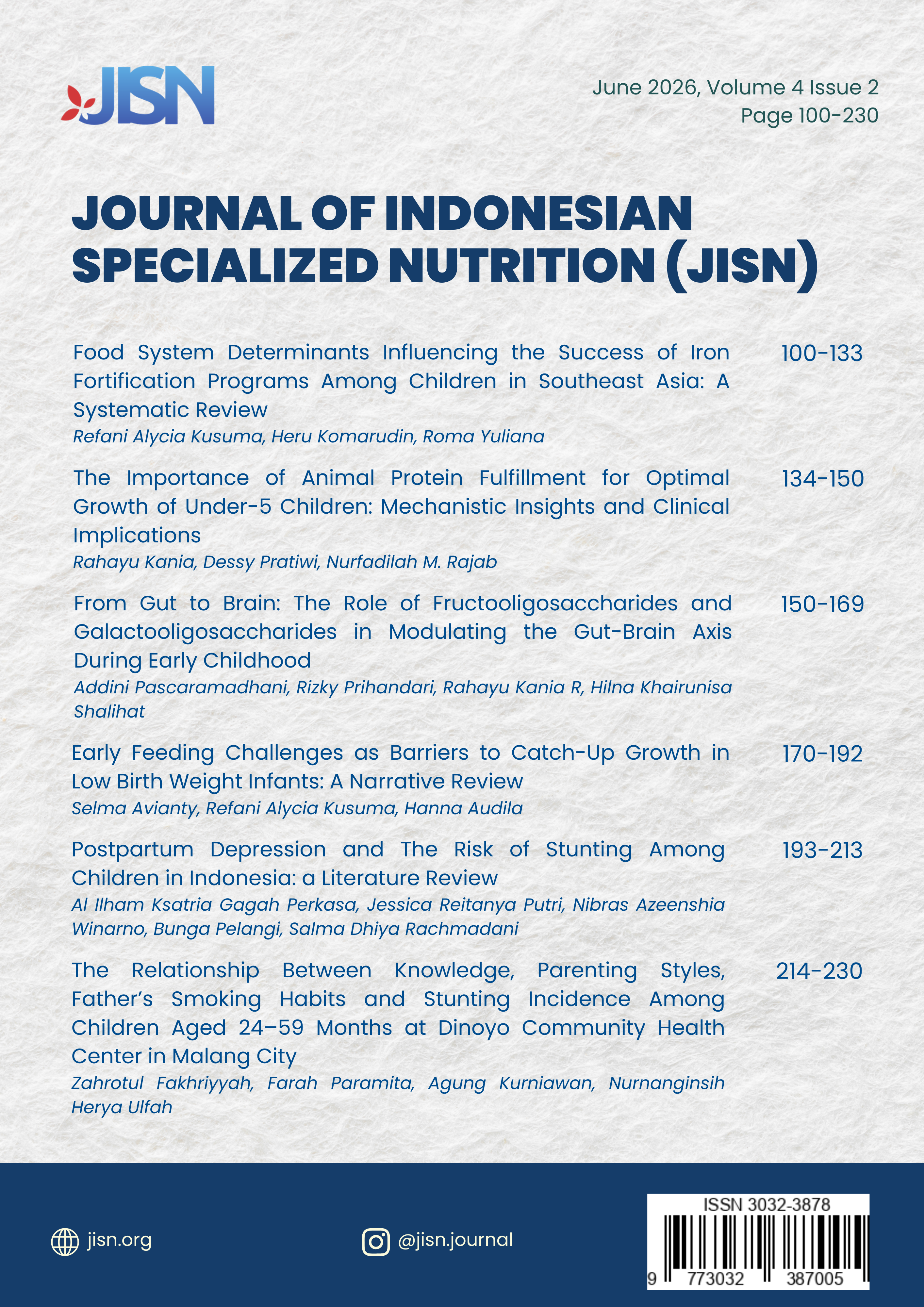
THE IMPORTANCE OF ANIMAL PROTEIN FULFILLMENT FOR OPTIMAL GROWTH OF UNDER-5 CHILDREN: MECHANISTIC INSIGHTS AND CLINICAL IMPLICATIONS
DOI:
https://doi.org/10.63953/jisn.v4i2.87Keywords:
Animal protein, Linear growth, First 1000 days, child nutritionAbstract
Background: Protein plays a fundamental role in growth regulation through its structural, metabolic, and signaling functions. Increasing evidence indicates that the consumption of animal-source foods is associated with improved linear growth and a reduced risk of stunting during infancy and early childhood. This review aimed to evaluate the contribution of animal protein intake to linear growth among children under five years of age. Methods: A literature review was conducted to synthesize current evidence from studies indexed in PubMed and Scopus between 2016 and 2026. Eligible publications included observational studies, randomized controlled trials (RCTs), and review articles that examined the relationship between animal protein intake and indicators of linear growth in children younger than five years. Results: Animal-source proteins, including those derived from fish, eggs, milk, and meat, were consistently associated with favorable linear growth outcomes during the first five years of life. Evidence from randomized trials and meta-analyses demonstrated modest but significant improvements in length-for-age z-scores (LAZ), while cohort studies reported lower stunting prevalence among children with higher animal-source food consumption. Nevertheless, the magnitude of these effects varied according to contextual factors, including dietary adequacy, maternal nutritional status, infection burden, and environmental conditions. Conclusion: Regular consumption of modest amounts of animal-source foods can contribute to measurable improvements in linear growth, with pooled evidence indicating significant benefits across low- and middle-income countries. However, the effectiveness of animal protein interventions is optimized when integrated with strategies addressing underlying determinants of growth.
References
Schwarzenberg SJ, Georgieff MK; Committee on Nutrition. Advocacy for Improving Nutrition in the First 1000 Days to Support Childhood Development and Adult Health. Pediatrics. 2018;141(2):e20173716. https://doi.org/10.1542/peds.2017-3716
Victora CG, Christian P, Vidaletti LP, Gatica-Domínguez G, Menon P, Black RE. Revisiting maternal and child undernutrition in low-income and middle-income countries: variable progress towards an unfinished agenda. Lancet. 2021;397(10282):1388-1399. https://doi.org/10.1016/S0140-6736(21)00394-9
Leroy JL, Frongillo EA. Perspective: What Does Stunting Really Mean? A Critical Review of the Evidence. Adv Nutr. 2019;10(2):196-204. https://doi.org/10.1093/advances/nmy101
Headey D, Hirvonen K, Hoddinott J. Animal Sourced Foods and Child Stunting. Am J Agric Econ. 2018;100(5):1302. https://doi.org/10.1093/ajae/aay053
Semba RD, Shardell M, Sakr Ashour FA, Moaddel R, Trehan I, Maleta KM, et al. Child Stunting is Associated with Low Circulating Essential Amino Acids. EBioMedicine. 2016;6:246-252. https://doi.org/10.1016/j.ebiom.2016.02.030
Millward DJ. Interactions between Growth of Muscle and Stature: Mechanisms Involved and Their Nutritional Sensitivity to Dietary Protein: The Protein-Stat Revisited. Nutrients. 2021;13(3):729. https://doi.org/10.3390/nu13030729
FAO. Dietary protein quality evaluation in human nutrition. FAO Food Nutr Pap. 2016;92:1-66.
Tessari P, Lante A, Mosca G. Essential amino acids: Master regulators of nutrition and environmental footprint? Sci Rep. 2016;6(1):26074. https://doi.org/10.1038/srep26074
Dror DK, Allen LH. Overview of Nutrients in Human Milk. Adv Nutr. 2018;9(Suppl 1):278S. https://doi.org/10.1093/advances/nmy022
Eaton JC, Dreker MR, Iannotti L, Lutter C, Kaganda J. Effectiveness of provision of animal-source foods for supporting optimal growth and development in children 6 to 59 months of age. Cochrane Database Syst Rev. 2019;2019(2):CD012818. https://doi.org/10.1002/14651858.CD012818.pub2
Shapiro MJ, Downs SM, Swartz HJ, Parker M, Quelhas D, Kreis K, et al. A Systematic Review Investigating the Relation Between Animal-Source Food Consumption and Stunting in Children Aged 6–60 Months in Low and Middle-Income Countries. Adv Nutr. 2019;10(5):827. https://doi.org/10.1093/advances/nmz018
Tadesse SE, Tariku A, Belachew T. Feeding practices of under-two children in Ethiopia: A systematic review and meta-analysis. PLoS One. 2026;21(2):e0342932. https://doi.org/10.1371/journal.pone.0342932
Tessema M, et al. Associations among High-Quality Protein and Energy Intake, Serum Transthyretin, Serum Amino Acids and Linear Growth of Children in Ethiopia. Nutrients. 2018;10(11):1776. https://doi.org/10.3390/nu10111776
Gat-Yablonski G, Phillip M. Nutritionally-Induced Catch-Up Growth. Nutrients. 2015;7(1):517. https://doi.org/10.3390/nu7010517
Asare H, Rosi A, Faber M, Smuts CM, Ricci C. Animal-source foods as a suitable complementary food for improved physical growth in 6 to 24-month-old children in low- and middle-income countries: a systematic review and meta-analysis of randomised controlled trials. Br J Nutr. 2022;128(12):2453-2463. https://doi.org/10.1017/S0007114522000290
Kaimila Y, et al. Consumption of Animal-Source Protein is Associated with Improved Height-for-Age z Scores in Rural Malawian Children Aged 12–36 Months. Nutrients. 2019;11(2):480. https://doi.org/10.3390/nu11020480
Shivakumar N, Jackson AA, Courtney-Martin G, Elango R, Ghosh S, Hodgkinson S, et al. Protein Quality Assessment of Follow-up Formula for Young Children and Ready-to-Use Therapeutic Foods: Recommendations by the FAO Expert Working Group in 2017. J Nutr. 2020;150(2):195-201. https://doi.org/10.1093/jn/nxz250
Kittisakmontri K, Lanigan J, Wells JC, Manowong S, Kaewarree S, Fewtrell M. Quantity and Source of Protein during Complementary Feeding and Infant Growth: Evidence from a Population Facing Double Burden of Malnutrition. Nutrients. 2021;14(19):3948. https://doi.org/10.3390/nu14193948
Herreman L, Nommensen P, Pennings B, Laus MC. Comprehensive overview of the quality of plant- and animal-sourced proteins based on the digestible indispensable amino acid score. Food Sci Nutr. 2020;8(10):5379-5391. https://doi.org/10.1002/fsn3.1809
Chipili G, Van Graan A, Lombard CJ, Van Niekerk E. The Efficacy of Fish as an Early Complementary Food on the Linear Growth of Infants Aged 6–7 Months: A Randomised Controlled Trial. Nutrients. 2021;14(11):2191. https://doi.org/10.3390/nu14112191
Mahfuz M, Alam MA, Das S, Fahim SM, Hossain MS, Petri WA, et al. Daily Supplementation With Egg, Cow Milk, and Multiple Micronutrients Increases Linear Growth of Young Children with Short Stature. J Nutr. 2020;150(2):394-403. https://doi.org/10.1093/jn/nxz253
Tadesse SE, Mekonnen TC, Adane M. Priorities for intervention of childhood stunting in northeastern Ethiopia: A matched case-control study. PLoS One. 2020;15(9):e0239255. https://doi.org/10.1371/journal.pone.0239255
Windiani IGAT, Adnyana IGANS. The relationship between animal protein consumption and stunting in children in Gianyar, Bali, Indonesia. Bali Med J. 2024;13(3):1413-1417. https://doi.org/10.15562/bmj.v13i3.5343
Miller V, Webb P, Micha R, et al. Defining diet quality: a synthesis of dietary quality metrics and their validity for the double burden of malnutrition. Lancet Planet Health. 2020;4(8):e352-e370. https://doi.org/10.1016/S2542-5196(20)30162-5
Parikh P, Semba R, Manary M, Swaminathan S, Udomkesmalee E, Bos R, et al. Animal source foods, rich in essential amino acids, are important for linear growth and development of young children in low- and middle-income countries. Matern Child Nutr. 2022;18(1):e13264. https://doi.org/10.1111/mcn.13264
Alonso S, Dominguez-Salas P, Grace D. The role of livestock products for nutrition in the first 1,000 days of life. Anim Front. 2019;9(4):24-31. https://doi.org/10.1093/af/vfz033
Sentika R, Setiawan T, Kusnadi, Rattu DJ, Yunita I, Basrowi RW, et al. Expert Consensus on Interprofessional Collaboration (IPC) Guidelines on Stunting Management in Indonesian Primary Healthcare (Puskesmas). 2024;17:e18749445352608. https://doi.org/10.2174/0118749445352608241119164446
Wahyuni FC, Karomah U, Basrowi RW, Sitorus NL, Lestari LA. The relationship between nutrition literacy and nutrition knowledge with the incidence of stunting: a scoping review. Amerta Nutr. 2024;7(3SP):71–85. https://doi.org/10.20473/amnt.v7i3SP.2023.71-85
Tanjung C, Fikri B, Prawitasari T, Massi N, Zainuddin AA, Juliaty A, et al. Comparative analysis of nutritional advice and a combined approach for addressing impending stunting in infants: a clinical trial. Nutrients. 2024;16(17):2832. https://doi.org/10.3390/nu16172832
Bahar M, Galistiani G, Eliyanti U. EE469 Cost-utility analysis of nutrient-dense supplementation in undernourished children in Indonesia. Value Health. 2024;27:S147–S148
Downloads
Published
Issue
Section
License
Copyright (c) 2026 Rahayu Kania, Dessy Pratiwi, Nurfadilah M Rajab

This work is licensed under a Creative Commons Attribution-ShareAlike 4.0 International License.
Authors retain copyright and grant the journal the right of first publication with the work simultaneously licensed under a Creative Commons Attribution-ShareAlike 4.0 International (CC-BY-SA) that allows others to share the work with an acknowledgment of the work's authorship and initial publication in this journal.
Authors are able to enter into separate, additional contractual arrangements for the non-exclusive distribution of the journal's published version of the work (e.g., post it to an institutional repository or publish it in a book), with an acknowledgment of its initial publication in this journal.
Authors are permitted and encouraged to post their work online (e.g., in institutional repositories or on their website) prior to and during the submission process, as it can lead to productive exchanges, as well as earlier and greater citation of published work.
LICENSE TO PUBLISH
- All material published by the Journal of Indonesian Specialized Nutrition is protected under International copyright and intellectual property laws. Journal of Indonesian Specialized Nutrition is licensed under a Creative Commons Attribution-ShareAlike 4.0 International (CC-BY-SA) or an equivalent license as the optimal license for the publication, distribution, use, and reuse of scholarly works.
- This license permits anyone to compose, repair, and make derivative creations even for commercial purposes, as long as appropriate credit and proper acknowledgment of the original publication from a journal are made to allow users to trace back to the original manuscript and author.
- You must give appropriate credit, provide a link to the license, and indicate if changes were made. You may do so in any reasonable manner, but not in any way that suggests the licensor endorses you or your use. If you remix, transform or build upon the material, you must distribute your contributions under the same license as the original.